|
We have seen that the charge carriers in metals are electrons which are in partially occupied conduction band. Electrons in fully occupied valence bands do not contribute to net current. We may understand this by a consideration of the effective mass of electrons near the top of the valence band. It may be seen that near the top of a band, the effective mass is negative. This means that in an electric field, the electrons which are near the top of the valence band are accelerated in the direction of the field while those near the bottom are accelerated in the opposite direction. The overall current in a filled band  is zero. Physically, this happens because there being no empty state in a filled band, the best that electrons can do is to trade places. is zero. Physically, this happens because there being no empty state in a filled band, the best that electrons can do is to trade places. |
| |
In semiconductors, the width of the forbidden band is small enough so that electrons near the top of a valence band can easily jump to the unoccupied conduction band. |
| |
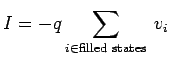
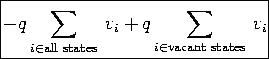
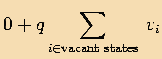
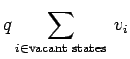
Consider what happens if one electron moves from near the top of valence band to the bottom of conduction band. The net effect of such a transition is to give a negative contribution to the current because had the electron been there at the top of the valence band it would have moved in the direction of the current (because of negative effective mass). Equivalently, the effect is to have one more electron moving opposite to the direction of the field. Mathematically, the current in a nearly filled band is given as follows. |