| |
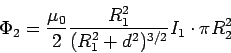
Consider two parallel rings  and and  with radii with radii  and and  respectively with a separation respectively with a separation  between their centres. Radius of between their centres. Radius of  is much smaller than that of is much smaller than that of  , so that the field experienced by , so that the field experienced by  due to a current in due to a current in  may be taken to be uniform over its area. Find the mutual inductance of the rings. may be taken to be uniform over its area. Find the mutual inductance of the rings. |
 |
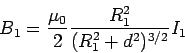
The field experienced by the smaller ring may be taken to be given by the expression for the magnetic field of a ring along its axis. We had earlier shown that at a distance  from the centre of the ring, the field along the axis is given by from the centre of the ring, the field along the axis is given by |
| |
By Faraday's law the emf in  is is 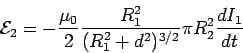 |
 is
is