 |
The flux enclosed by the second loop, (called the secondary ) is
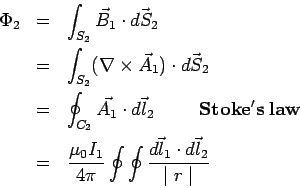
Clearly, 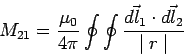
It can be seen that the expression is symmetric between two loops. Hence we would get an identical expression for  . This expression is, however, of no significant use in obtaining the mutual inductance because of rather difficult double integral. . This expression is, however, of no significant use in obtaining the mutual inductance because of rather difficult double integral.
Thus a knowledge of mutual inductance enables us to determine, how large should be the change in the current (or voltage) in a primary circuit to obtain a desired value of current (or voltage) in the secondary circuit. Since  , we represent mutual inductance by the symbol , we represent mutual inductance by the symbol  . The emf . The emf  in the secondary circuit is given by in the secondary circuit is given by 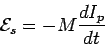 , where , where  is the variable current in the primary circuit. is the variable current in the primary circuit.
Units of  is that of Volt-sec/Ampere which is known as Henry (h) is that of Volt-sec/Ampere which is known as Henry (h)
Example 22 Example 23 Exercise 1 Exercise 2 |

