 |
According to Faraday's law, a changing magnetic flux in a loop causes an emf to be generated in that loop. Consider two stationary coils carrying current. The first coil has  turn and carries a current turn and carries a current  . The second coil contains . The second coil contains  turns. The current in the first coil is the source of a magnetic field turns. The current in the first coil is the source of a magnetic field  in the region around the coil. The second loop encloses a flux in the region around the coil. The second loop encloses a flux 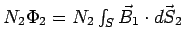 , where , where  is the surface of one turn of the loop. If the current is the surface of one turn of the loop. If the current  in the first coil is varied, in the first coil is varied,  , and consequently , and consequently  will vary with time. will vary with time.
The variation of  causes an emf causes an emf
 to be developed in the second coil. Since to be developed in the second coil. Since  is proportional to is proportional to  , so is , so is  . The emf, which is the rate of change of flux is, therefore, proportional to . The emf, which is the rate of change of flux is, therefore, proportional to  , , 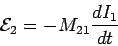
where  is a constant, called the mutual inductance of the two coils, which depends on geometrical factors of the two loops, their relative orientation and the number of turns in each coil. is a constant, called the mutual inductance of the two coils, which depends on geometrical factors of the two loops, their relative orientation and the number of turns in each coil.
|

