 |
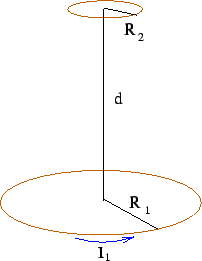
which gives 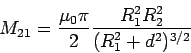
The expression above is obviously not symmetrical between the loops. This is because of our assumption of uniform field over  . The approximation will be legitimate if the dimensions of . The approximation will be legitimate if the dimensions of  is negligibly small, i.e. if is negligibly small, i.e. if  is taken to be a dipole, is taken to be a dipole,  , so that from , so that from  , the other loop looks like a point. In such a case, , the other loop looks like a point. In such a case,
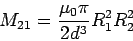
In the next example we assume that the current is changing in the dipolar loop and determine the emf generated in the larger loop. |
