Class B amplifier:
The efficiency ( h ) of class A amplifier is poor. The reason is that these circuits draw considerable current from the supply even in the absence of input signals.
In class B operation the transistor collector current flows for only 180° of the ac cycle. This implies that the Q-point is located approximately at cutoff on both dc and ac load lines. The advantages of class B operation are
- Lower transistor power dissipation
- Reduced current drain.
Push pull circuit:
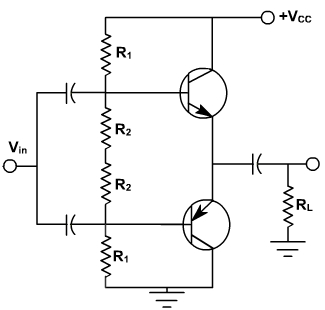
When a transistor operates in class B, it clips off a half cycle. To avoid the resulting distortion, two transistors are used in push pull arrangement. This means that one transistor conducts during positive half cycle and other transistor conducts during negative half cycle. The distortion is low, load power is large and efficiency ( h ) is more. fig. 3, shows how a npn and pnp transistor emitter followers are connected in push pull arrangement.
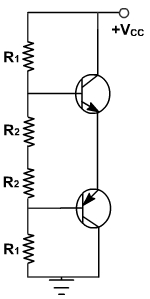
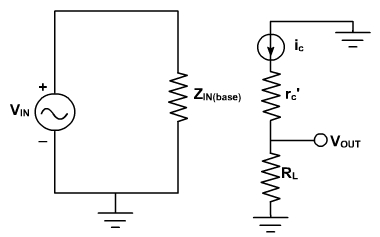
The dc & ac equivalent circuit are shown in fig. 4 & fig. 5. The biasing resistors are selected so that Q-point is set at cutoff. This biases the emitter diode of each transistor between 0.6V and 0.7V
i.e. I CQ = 0.
Because the biasing resistors are equal each emitter diode is biased with the same voltage. As a result half the supply voltage is dropped across each transistor.
VCEQ = VCC / 2.
Fig. 3