Voltage gain:
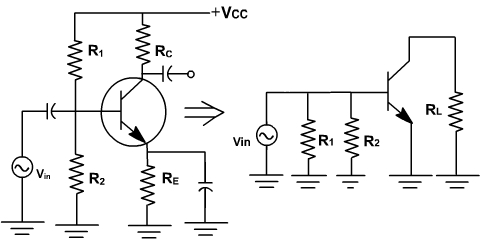
To find the voltage gain, consider an unloaded CE amplifier. The ac equivalent circuit is shown in fig. 3. The transistor can be replaced by its collector equivalent model i.e. a current source and emitter diode which offers ac resistance r'e.
Fig. 3
The input voltage appears directly across the emitter diode.
Therefore emitter current ie = Vin / r'e.
Since, collector current approximately equals emitter current and iC = ie and vout = - ie RC (The minus sign is used here to indicate phase inversion)
Further vout = - (Vin RC) / r'e
Therefore voltage gain A = vout / vin = -RC / r'e
The ac source driving an amplifier has to supply alternating current to the amplifier. The input impedance of an amplifier determines how much current the amplifier takes from the ac source.
In a normal frequency range of an amplifier, where all capacitors look like ac shorts and other reactance are negligible, the ac input impedance is defined as
zin= vin/ iin
Where vin, iin are peak to peak values or rms values
The impedance looking directly into the base is symbolized zin (base) and is given by
Z in(base) = vin / ib ,
Since,v in = ie r'e
» bi b r'e
zin (base) = b r'e.
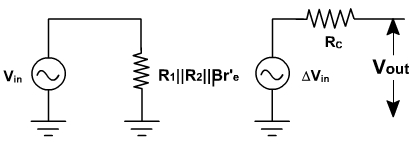
From the ac equivalent circuit, the input impedance zin is the parallel combination of R1 , R2 and b r'e.
Zin = R1 || R2 || b r'e
The Thevenin voltage appearing at the output is
vout = A vin
The Thevenin impedance is the parallel combination of RC and the internal impedance of the current source. The collector current source is an ideal source, therefore it has an infinite internal impedance.
zout = RC.
The simplified ac equivalent circuit is shown in fig. 4.
Fig. 4