AC Equivalent Circuit:
When the mounted crystal is not vibrating, it is equivalent to a capacitance Cm, because it has two metal plates separated by dielectric, Cm is known as mounting capacitance.
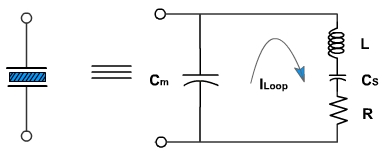
Fig. 2
When the crystal is vibrating, it acts like a tuned circuit. Fig. 2, shows the ac equivalent circuit of a crystal vibrating at or near its fundamental frequency. Typical values are L is henrys, C in fractions of a Pico farad, R in hundreds of ohms and Cm in Pico farads
Ls = 3Hz, Cs = 0.05 pf, Rs = 2K, Cm = 10 pf.
The Q of the circuit is very very high. Compared with L-C tank circuit. For the given values, Q comes out to be 3000. Because of very high Q, a crystal leads to oscillators with very stable frequency values.
The series resonant frequency fS of a crystal is the sonant frequency of the LCR branch. At this frequency, the branch current reaches a maximum value because Ls resonant with CS.
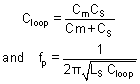
Above fS, the crystal behaves inductively. The parallel resonant frequency is the frequency at which the circulating or loop current reaches a maximum value. Since this loop current must flow through the series combination of CS and Cm, the equivalent Cloop is
Since Cloop > CS, therefore, fp > fS.
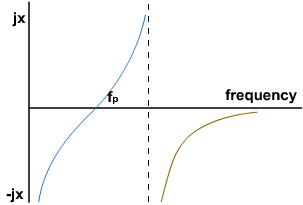
Since Cm > CS, therefore, Cm || CS is slightly lesser than CS. Therefore fP is slightly greater than fS. Because of the other circuit capacitances that appear across Cm the actual frequency will lie between fS and fP. fS and fP are the upper and lower limits of frequency. The impedance of the crystal oscillator can be plotted as a function of frequency as shown in fig. 3.
At frequency fS, the circuit behaves like resistive circuit. At fP the impedance reaches to maximum, beyond fP, the circuit is highly capacitive.
The frequency of an oscillator tends to change slightly with time. The drift is produced by temperature, aging and other causes. In a crystal oscillator the frequency drift with time is very small, typically less than 1 part in 106 per day. They can be used in electronic wristwatches. If the drift is 1 part in 1010, a clock with this drift will take 30 years to gain or lose 1 sec.
Fig. 3
Crystals can be manufactured with values of fs as low as 10 kHz; at these frequencies the crystal is relatively thick. On the high frequency side, fs can be as high as 1- MHz; here the crystal is very thin.
The temperature coefficient of crystals is usually small and can be made zero. When extreme temperature stability is required, the crystal may be housed in an oven to maintain it at a constant temperature. The high Q of the crystal also contributes to the relatively drift free oscillation of crystal oscillators.