Low pass filter with adjustable corner frequency
One advantage of active filter is that it is often quite simple to vary parameter values. As an example, a first-order low-pass filter with adjustable corner frequency is shown in fig. 3.
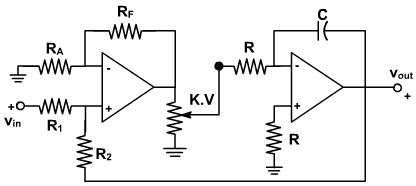
Fig. 3
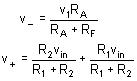
The voltage at the opamp inputs are given by
Setting v + = v -, we obtain the voltage, v1, as follows:
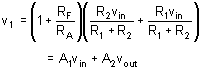
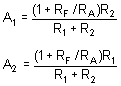
where
The second opamp acts as an inverting integrator, and
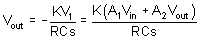
Note that we use upper case letters for the voltages since these are functions of s. K is the fraction of V1 sent to the integrator. That is, it is the potentiometer ratio, which is a number between 0 and 1.
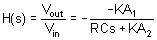
The transfer function is given by
The dc gain is found by setting s = 0 (i.e., jω =0)

The corner frequency is at KA2 / RC. Thus, the frequency is adjustable and is proportional to K. Without use of the opamp, we would normally have a corner frequency which is inversely propostional to the resistor value. With a frequency proportional to K, we can use a linear taper potentiometer. The frequency is then linearly proportional to the setting of the potentiometer.
Example - 2
Design a first order adjustable low-pass filter with a dc gain of 10 and a corner frequency adjustable from near 0 t0 1 KHz.
Solution:
There are six unknowns in this problems (RA, RF, R1, R2, R and C) and only three equations (gain, frequency and bias balance). This leaves three parameters open to choice. Suppose we choose the following values:
C = 0.1 µF
R = 10 KΩ
R1 = 10KΩThe ratio of R2 to R1 is the dc gain, so with a given value of R1 = 10KΩ, R2 must be 100 kΩ. We solve for A1 and A2 in the order to find the ratio, RF / RA.
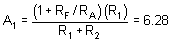
The maximum corner frequency occurs at K = 1, so this frequency is set to 2π x 1000. Since R and C are known, we find A2 = 6.28. Since A2 and A1 are related by the dc gain, we determine A1 / A2 = 10 and A1 = 62.8. Now, substituting the expression for A2, we find
and since
we find RF / RA = 68. RA is chosen to achieve bias balance. The impedance attached to the non-inverting input is 10 KΩ || 100 KΩ = 10 KΩ.
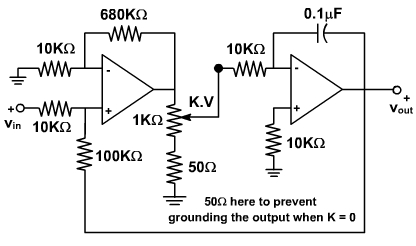
Fig. 4
If we assume that RF is large compared with RA ( we can check this assumption after solving for these resistors), the parallel combination will be close to the value of RA. We therefore can choose RA = 10 KΩ. With this choice of RA, RF is found to be 680KΩ and bias balance is achieved. The complete filter is shwn in fig. 4.