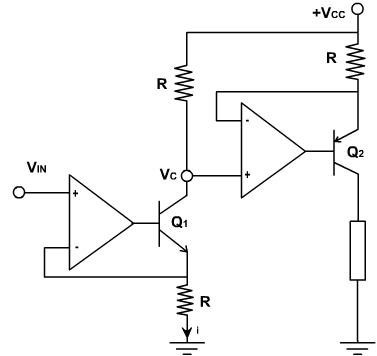
Another circuit in which load current increases as Vin increases is shown in fig. 5.
The current through the first transistor is
i = vin / R
This current produces a collector voltage of vC = vCC– i R = vCC – vin
Since this voltage drives the non-inverting input of the second op-amp. The inverting voltage is vCC- vin to a close approximation. This implies that the voltage across the final R is
vCC - (vCC - vin ) = vin
and the output current .
iout = vin / R
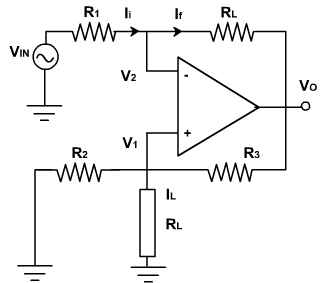
As before, this output current must satisfy the condition,that Iout/ bdc must be less than the Iout(max) of the OPAMP. Furthermore, the load voltage cannot exceed vCC- vin because of transistor saturation, therefore Iout R must be less than vCC- vin.This current source produces unidirectional load current. fig. 6, shows a Howland current source, that can produce a bi-directional load current.
Fig. 5
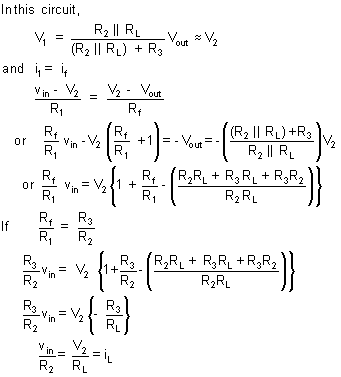
The maximum load current is VCC/ R. In this circuit v in may be positive or negative.
Fig. 6