Crystal Oscillator:
Some crystals found in nature exhibit the piezoelectric effect i.e. when an ac voltage is applied across them, they vibrate at the frequency of the applied voltage. Conversely, if they are mechanically pressed, they generate an ac voltage. The main substances that produce this piezoelectric effect are Quartz, Rochelle salts, and Tourmaline.
Rochelle salts have greatest piezoelectric activity, for a given ac voltage, they vibrate more than quartz or tourmaline. Mechanically, they are the weakest they break easily. They are used in microphones, phonograph pickups, headsets and loudspeakers.
Tourmaline shows the least piezoelectric activity but is a strongest of the three. It is also the most expensive and used at very high frequencies.
Quartz is a compromise between the piezoelectric activity of Rochelle salts and the strength of tourmaline. It is inexpensive and easily available in nature. It is most widely used for RF oscillators and filters.
The natural shape of a quartz crystal is a hexagonal prism with pyramids at the ends. To get a useable crystal out of this it is sliced in a rectangular slap form of thickness t. The number of slabs we can get from a natural crystal depends on the size of the slabs and the angle of cut.
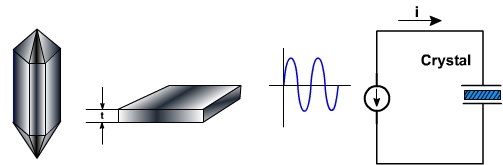
Fig. 1
For use in electronic circuits, the slab is mounted between two metal plates, as shown in fig. 1. In this circuit the amount of crystal vibration depends upon the frequency of applied voltage. By changing the frequency, one can find resonant frequencies at which the crystal vibrations reach a maximum. Since the energy for the vibrations must be supplied by the ac source, the ac current is maximized at each resonant frequency. Most of the time, the crystal is cut and mounted to vibrate best at one of its resonant frequencies, usually the fundamental or lowest frequency. Higher resonant frequencies, called overtones, are almost exact multiplies of the fundamental frequency e.g. a crystal with a fundamental frequency of 1 MHz has a overtones of 2 MHz, 3 MHz and so on. The formula for the fundamental frequency of a crystal is
f = K / t.
where K is a constant that depends on the cut and other factors, t is the thickness of crystal, f is inversely proportional to thickness t. The thinner the crystal, the more fragile it becomes and the more likely it is to break because of vibrations. Quartz crystals may have fundamental frequency up to 10 MHz. To get higher frequencies, a crystal is mounted to vibrate on overtones; we can reach frequencies up to 100 MHz.