|
Even and odd signals: |
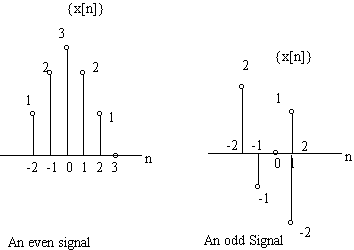
| A real valued signal {x[n]} is referred to as an even signal if it is identical to its time reversed counterpart ie, if
|
| {x[n]} = {x[-n]} |
|
A real signal is referred to as an odd signal if |
| {x[n]} = {-x[-n]} |
| An odd signal has value 0 at n = 0 as
x[0] = -x[n] = - x[0] |
 |
Given any real valued signal {x[n]} we can write it as a sum of an even signal and an odd signal. Consider the signals
Ev ({x[n]}) = {xe[n]} = {1/2 (x[n] + x[-n])}
|
| and Od ({x[n]}) = {xo[n]} = {1/2(x[n] -x [-n])} |
| We can see easily that |
| {x[n]} = {xe[n]} + {xo[n]} |
| The signal {xe[n]} is called the even part of {x[n]}. We can verify very easily that
{xe[n]} is an even signal. Similarly,
{xo[n]} is called the odd part of {x[n]} and is an odd signal. When we have complex valued signals we use a slightly different terminology. A complex valued signal {x[n]} is referred to as a conjugate symmetric signal if
|
| {x[n]} = {x*[-n]} |
where x* refers to the complex conjugate of x. Here we do reflection and complex conjugation. If {x[n]} is real valued this is same as an even signal.
A complex signal {x[n]} is referred to as a conjugate antisymmetric signal if |
| {x[n]} = {-x*[-n]} |
|
We can express any complex valued signal as sum conjugate symmetric and conjugate antisymmetric signals. We use notation similar to above |
| Ev({x[n]}) = {xe[n]} = {1/2(x[n] + x*[-n])} |
| and
Od ({[n]}) = {xo[n]} = {1/2(x[n] - x*[-n])} |
| then {x[n]} = {xe[n]} + {xo[n]} |
| We can see easily that
{xe[n]} is conjugate symmetric signal and
{xo[n]} is conjugate antisymmetric signal. These definitions reduce to even and odd signals in case signals takes only real values. |


