COMPOUND SEMICONDUCTOR FIELD-EFFECT TRANSISTORS(MESFETs)
- In the Shockley model, it is assumed that the electron drift velocity
 is proportional to the absolute value of the longitudinal electric
field E = |dV(x)/dx|, i.e.,
=
is proportional to the absolute value of the longitudinal electric
field E = |dV(x)/dx|, i.e.,
=  E,
where
is the low-field electron mobility.
E,
where
is the low-field electron mobility.
- Under GCA, the potential drop dV across a small length dx along
the channel can be written as

where Id is the drain current, dR is the channel resistance of the small section of length dx, and W is the gate width.
- Equation (6.4) is valid below pinch-off, i.e.,
.gif) <
d.
<
d.
- Substituting the expression for dd(x) from Eqn.(6.1) into Eqn.(6.4),
and integrating x from 0 to L, and V(x) from 0 to
 ,
the following drain current characteristic is obtained
,
the following drain current characteristic is obtained
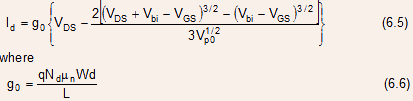
is the conductance of the undepleted channel.
- Equation (6.5) is referred to as the fundamental equation for FETs,
and is valid only for

 .
.
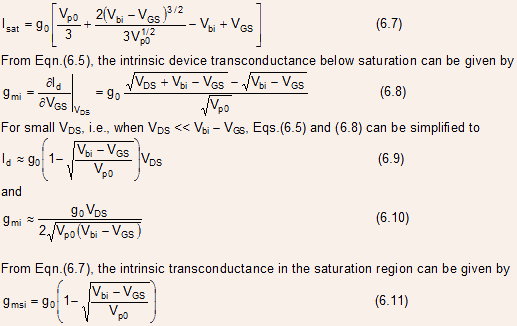
- From Eqn.(6.5), it can be easily shown that the channel conductance
 becomes zero when
= ,
hence, it can be argued that the drain current saturates at this value
of ,
called the saturation voltage
becomes zero when
= ,
hence, it can be argued that the drain current saturates at this value
of ,
called the saturation voltage  and, according to the Shockley model, =
,
and the corresponding drain saturation current
and, according to the Shockley model, =
,
and the corresponding drain saturation current  becomes
EXAMPLE 6.2: Consider the n-channel GaAs MESFET of Example 6.1 with L = 1
 and W = 5 .
Determine the saturation drain voltage, drain current, and the transconductance
for
and W = 5 .
Determine the saturation drain voltage, drain current, and the transconductance
for  = 0.3 V, and VDS = 0.1 V and 0.5 V. Assume n = 8500
  .
.SOLUTION: The saturation drain voltage
=
= -
 = 0.3 + 0.54 = 0.24 V.
The conductance of the undepleted channel

For the first case,
(= 0.1 V) is less (=
0.24 V), hence, the device is under linear mode of operation, and
the drain current is given by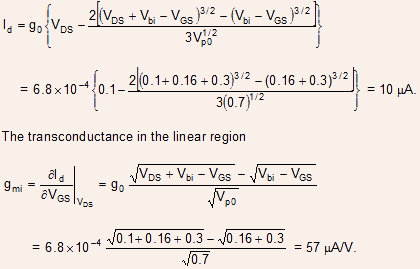
Since
is quite small, hence, from the approximate relation given by Eqn.(6.10),
 = 60 A/V, which is quite close to the answer obtained.
Now, for the second case,
(= 0.5 V) is greater than (=
0.24 V), therefore, the device is under saturation mode of operation,
and the drain current is given by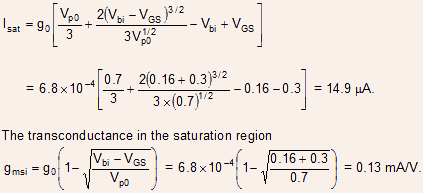
 Velocity Saturation Model
 - In the Shockley model, it was assumed that the carrier drift velocity
increases linearly with the electric field, and from current continuity,
it follows that the carrier drift velocity at the drain side of the
gate approaches infinity as the pinch-off condition
= d is reached, which is, of course, absurd.
- Rather, carrier velocity saturation would occur at sufficiently
high electric fields, which gives an alternate mechanism for current
saturation in the device.
- A simple way of dealing with carrier velocity saturation is to assume
a two-piece linear velocity-field relationship of the form

where is the carrier saturation velocity, and
  is
the electric field required for carrier velocity saturation.
is
the electric field required for carrier velocity saturation.
- For E(L)
 ,
the results from the Shockley model are still valid.
,
the results from the Shockley model are still valid.
- Hence, the new saturation voltage, defined as the drain-source voltage
at the onset of carrier velocity saturation, can be determined from
Eqn.(6.4) in combination with Eqns.(6.1) and (6.5), resulting in the
expression
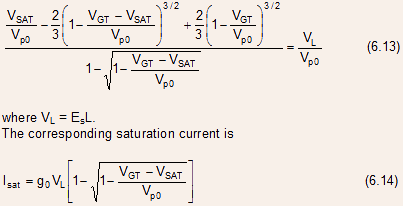
- From Eqn.(6.13), it can be seen that the saturation voltage corresponding
to the Shockley model, i.e.,
= is
recovered when
 >>
1.
>>
1.
- On the other hand, in the opposite limit, i.e., when <<
1, which corresponds to near velocity saturation in the entire channel,
it is found that

 ,
where it is assumed that <<
z(1 - z), where
,
where it is assumed that <<
z(1 - z), where 
or intermediate cases,
can be found either by solving Eqn.(6.13) as a third order equation
in  or by solving the equation numerically.
- However, a simple interpolation formula for the saturation voltage
can be established by combining the results for the two limiting cases,
i.e.,

- Likewise, an interpolation formula, valid for devices with relatively
low pinch-off voltages, can be found for the saturation current

- Note: the square law given by Eqn.(6.16) is of the same form as
that used in the SPICE modeling of he saturation current in JFETs,
and it has also been used to describe the saturation characteristics
in SPICE simulation of GaAs MESFETs.
- Later, a more general version of Eqn.(6.16) was proposed, which
covered devices with higher pinch-off voltages

- Equation (6.17) can be used to determine the dependence of
and the device transconductance on channel doping, gate length, electron
mobility, and saturation velocity.
- The velocity saturation model now allows making a rough estimate
of the intrinsic high speed performance of the MESFET.
- From Eqn.(6.16), one can calculate the transconductance at the saturation
point

- Furthermore, it may be argued that the gate-source capacitance
 at saturation will be of the order of sLW/d, hence, the cutoff frequency
can be written approximately as
at saturation will be of the order of sLW/d, hence, the cutoff frequency
can be written approximately as

- From Eqn.(6.20), it is obvious that a high
 can be obtained using a small L and a small
  ,
however, it is also desirable to have a device with a high current
level, which requires a large doping sheet density (
,
however, it is also desirable to have a device with a high current
level, which requires a large doping sheet density ( d),
thus, the best tradeoff is therefore to use a thin and highly doped
channel.
d),
thus, the best tradeoff is therefore to use a thin and highly doped
channel.
EXAMPLE 6.3: Assuming
= 2 105 m/sec, determine the saturation drain voltage, saturation
drain current, and the transconductance in the saturation region for
=
0.5 V for the n-channel GaAs MESFET considered in Examples 6.1 and
6.2, assuming velocity saturation of the carriers in the channel.
Compare the results with those obtained in Example 6.2. Also, estimate
the cutoff frequency
of the device. Use the data given in Examples 6.1 and 6.2.SOLUTION: The electric field required for velocity saturation in the channel Es = vs/ = 2 107/8500 = 2.35 kV/cm. Thus,
= L
= 0.24 V. Since and
(= 0.7 V) are of the order, therefore, the saturation drain voltage
can approximately be given by 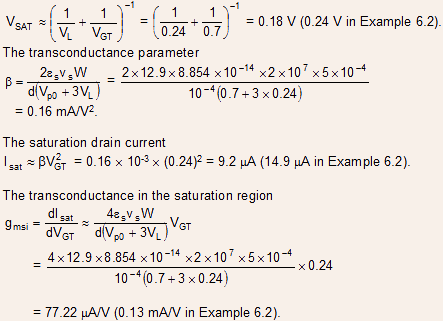 Effect
of Source/Drain Series Resistance
Effect
of Source/Drain Series Resistance
- Source and drain series resistance
 and
and  may play important roles in determining the I-V characteristics of
GaAs MESFETs.
may play important roles in determining the I-V characteristics of
GaAs MESFETs.
- These resistances can be taken into account by using the following
relationships between the extrinsic (lower case subscripts) and intrinsic
(upper case subscripts) drain-source and gate-source bias voltages.
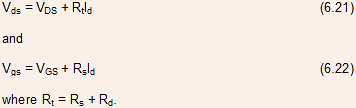
The saturation current in terms of the extrinsic gate voltage swing
is readily obtained by combining Eqns.(6.16) and (6.22):