Lecture 10 : Transmisssion Line Calculations Using Smith Chart
Smith chart is a very useful tool for solving transmission line problems. A variety of calculations can be carried
out using the Smith chart without getting into complex computations.
(A)
Calculation of Load Reflection Co-efficient
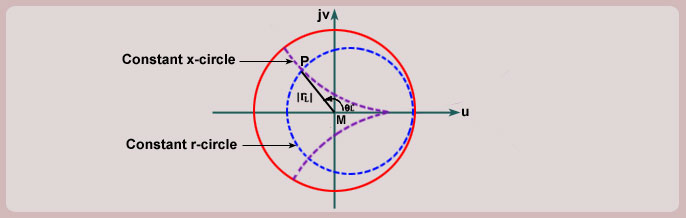
Let us find the reflection coefficient for a load impedance . First normalize the impedance with the
characteristic impedance to get
Identify the constant resistance and the constant reactance
circles corresponding to and respectively.
Intersection of the two circles marks the load impedance on
the Smith chart as point P (see Figure )
Measure the radial distance of P from the centre of the chart M.
This is the magnitude of the load
reflection coefficient .
The angle which the radius vector MP makes with
the -axis is the phase of the load reflection coefficient .
Note
The Smith chart should be placed in
such a way that the most clusterred portion of the chart lies on the right side.
The horizontal line towards
right then indicates the real - axis.


 - axis.