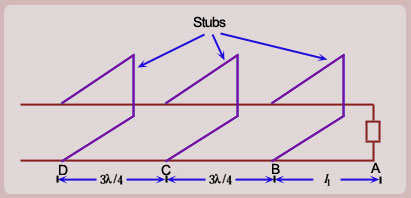
Inorder to overcome the drawback of double-stub mathching technique one can use three stubs seperated by
 distance, instead of the two stubs (see Figure). One still uses only two adjacent stubs (B, C or C, D) at a time
for matching purpose. For those loads which have distance, instead of the two stubs (see Figure). One still uses only two adjacent stubs (B, C or C, D) at a time
for matching purpose. For those loads which have  outside the forbidden region we use stub B and C as
used earlier and stub D is disconnected. The disconnection is not physical and is achieved by simply adjusting
the length of the stub to outside the forbidden region we use stub B and C as
used earlier and stub D is disconnected. The disconnection is not physical and is achieved by simply adjusting
the length of the stub to  . The . The  -stub appears open at the junction point D. -stub appears open at the junction point D.
|