Lecture 16 : Impedance Matching using Transmission Line continues
Double-Stub Matching Technique (contd.)
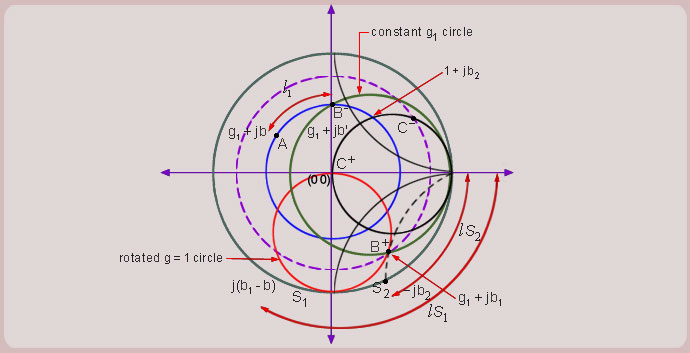
We can note the steps involved in the double stub matching as follows:
(a)
Mark the admittance on the Smith chart (Point A).
(b)
Move on constant VSWR circle passing through A by a distance to reach .
(c)
Move along the constant-conductance (constant- ) circle to reach ( a point on the rotated circle).
Note that a stub at B will change only the reactive part and therefore we move on a circle which keeps the real
part of same while going from to .
(d)
Transform admittance at to by moving a distance of on a constant VSWR circle
passing through . The point must be lying to the circle. Let the transformed admittance at
point be .
(e)
Add a stub to give susceptance at location C so as to move the point to which is the matched point.
(f)
To calculate the length of the first stub we note that this stub must provide a susceptance which is the
difference between the susceptances at and . That is, the stub susceptance is equal to .
Mark the susceptance on the chart to get point . Distance from to in the anticlockwise
direction gives the length of the first stub.
(g)
The second stub should have a susceptance of . To get the length of the second stub the procedure is
same as that used in the single stub matching. That is, mark on the Smith chart to get point .
Measure distance in anti-clockwise direction to give .
Limitation
The whole matching process relies
on the fact that by moving along a constant conductance circle one can go from
point to . ( lies on the
rotated circle). If this step is not realizable then the whole matching process
is unrealizable.
If point lies in the hatched region, moving along constant-g circle can never bring a point on rotated g=1
circle. Hence that admittance cannot be matched by the Double Stub method.