It is important to note that No Signal can travel with infinite velocity. That is to say that if a voltage or current changes at
some location, its effect cannot be felt instantaneously at some other location. There is a finite delay between the
'cause' and the effect. This is called the ' Transit Time' effect.
Consider the two-conductor line which is connected to a sinusoidal signal generator of frequency at one end
and a load impedance at the other end. Due to the transit time effect the voltage applied at AA' will not appear
instantaneously at BB'.
Let the signal travel with velocity along the line. Then the Transit time
, = length of the line.
At some instant let the voltage at AA' be . Then will appear at BB' only after . However, during this time the
voltage at AA' changes to (say ) .
Important Observation
Even for ideal conductors i.e., no resistance, there is a voltage difference between AA' and BB'
When is transmit-time effect important?
Ideally the transit time effect should be included in analysis of all electrical circuits. However if the time period of the
signal is much larger than the transit time, we may ignore the effect of transmit time. That is, the
transit time effect can be neglected if
Transit time effect becomes important when the length of the line becomes comparable to the wavelength.
As the frequency increases, the wavelength reduces, and the transit time effect becomes more and more important.

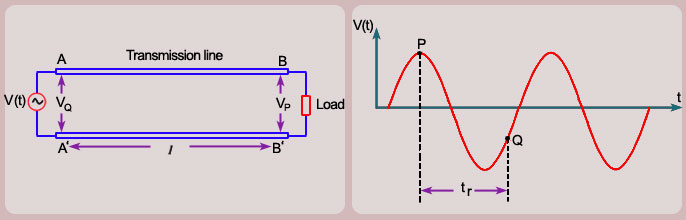


 at one end
and a load impedance at the other end. Due to the transit time effect the voltage applied at AA' will not appear
instantaneously at BB'.
at one end
and a load impedance at the other end. Due to the transit time effect the voltage applied at AA' will not appear
instantaneously at BB'.  along the line. Then the Transit time
 ,
,  = length of the line.
  . Then
  will appear at BB' only after
  . However, during this time the
voltage at AA' changes to (say )
. However, during this time the
voltage at AA' changes to (say )  .
.  is much larger than the transit time, we may ignore the effect of transmit time. That is, the
transit time effect can be neglected if
is much larger than the transit time, we may ignore the effect of transmit time. That is, the
transit time effect can be neglected if