Module 2 : Transmission Lines
Lecture 2 : Transmission Lines in Practice

Various Types Of Transmission Line
   
As the name suggests, the transmision line is a structure which can transport electrical energy from one point to another.

 
At low frequencies, a transmission line consists of two linear conductors separated by a distance. When an electrical source is applied between the two conductors, the line gets energized and the electrical energy flows along the length of the conductors.
   
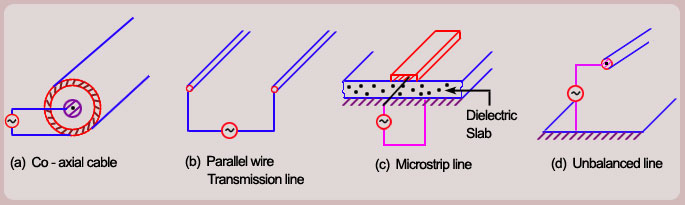
A two-conductor transmission line may appear in any of the forms shown in the figure
   
Co-axial cable
Consists of a solid conducting rod surrounded by the two conductors. This line has good isolation of the electrical energy and therfore has low Electromagnetic Interference (EMI).
 
Parallel wire transmission line
Consists of two parallel conducting rods. In this case the electrical energy is distributed between and around the rods. Theoretically the electric and magnetic fields extend over infinite distance though their strength reduces as the distance from the line. Obviously this line has higher EMI.
 
Microstrip line
Consists of a dielectric substrate having ground plane on one side and a thin metallic strip on the other side. The majority of the fields are confined in the dielectric substrate between the strip and the ground plane. Some fringing field exist above the substrate which decay rapidly as a function of height. This line is usually found in printed circuit boards at high frequencies.
 
Balanced and Un-balanced line
If the two conductors are symmetric around the ground, then the line is called the balanced line, otherwise the line is an un-balanced line. Transmission lines (a), (c) and (d) are un-balanced line, whereas the line (b) is a balanced line.