| |
Transverse Magnetic Mode |
|
A rectangular waveguide with cross-section  is shown in the figure below is shown in the figure below |
|
|
|
|
The walls of the waveguide are made of ideal conductior and the medium filling the waveguide is ideal dielectric. |
|
|
|
As a convention and the  -axis is oriented along the broader dimension of the wave guide, and the -axis is oriented along the broader dimension of the wave guide, and the  -axis is
oriented along the shorter dimension of the waveguide. The -axis is
oriented along the shorter dimension of the waveguide. The  -axis is oriented along the length of the waveguide
and the waveguide is assumed to be infinite length. -axis is oriented along the length of the waveguide
and the waveguide is assumed to be infinite length. |
|
|
|
For transverse magnetic mode, we have  and and  . The transverse fields are therefore represented in terms of . The transverse fields are therefore represented in terms of  components only. components only. |
|
|
|
The wave equation is to be solved for with appropriate boundary conditions. In Cartesian co-ordinates the wave equation for can be written as |
|
|
|
 -------- (6.35) -------- (6.35) |
|
| |
|
|
The equation can be solved by the separation of variables i.e by assuming that is given as |
|
 --------(6.36) --------(6.36) |
|
|
|
|
The fields are assumed to be of sinosoidal nature with an angular frequency  . . |
| |
|
|
Substituting for from 6.36 into 6.35, we get |
|
 -------- (6.37) -------- (6.37) |
|
| |
| |
|
|
|
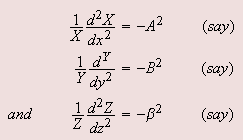
Note that in equation 6.37 the first term is a function of  , the second term is a function of , the second term is a function of  only, the third term is a function of only, the third term is a function of  only and fourth term is a constant. Since the equation is to be satisfied for every value of only and fourth term is a constant. Since the equation is to be satisfied for every value of  each term in equation 6.37 must be constant i.e each term in equation 6.37 must be constant i.e |
|
|
|
 |
|
| ---------- (6.38) |
| |
| ---------- (6.39) |
| |
| ---------- (6.40) |
| |
|
 and and  are real constants. are real constants. |
|
|
|
From the physical understanding of reflection of waves from parallel conducting boundaries we expect a standing wave kind of behaviour in and directions and a travelling wave kind of behaviour in direction. In any case, we expect a wave phenomenon in direction which can be properly represented by putting a negative sign infront of the constant  , ,  and and  . Instead of negative sign if the positive sign was used the solutions will have real exponential functions which would not represent the wave phenomenon. . Instead of negative sign if the positive sign was used the solutions will have real exponential functions which would not represent the wave phenomenon. |
|
|
|
The equations 6.38, 6.39 and 6.40 can be re-written as |
|
|
|
| ---------- (6.41) |
| |
| ---------- (6.42) |
| |
| ---------- (6.43) |
| |
|
These equations are identical to the transmission line equations. |
|
|
|
The solution to equations 6.41, 6.42 and 6.43 can be appropriately written as |
|
|
|
 |
---------- (6.44) |
| ---------- (6.45) |
| |
| ---------- (6.46) |
|
where  are arbitrary constants which are to be evaluated by boundary conditions. are arbitrary constants which are to be evaluated by boundary conditions. |
|
|
|
If we assume that waveguide is of infinite length, we can take only one travelling wave in  -direction. We can -direction. We can |
|
then choose  . Substituting for . Substituting for  from 6.44, 6.45 and 6.46 into equation 6.36 the general solution for can be written as from 6.44, 6.45 and 6.46 into equation 6.36 the general solution for can be written as |
|
 |
---------- (6.47) |
|


.jpg)


