| |
General Approach to Wave Guide Analysis |
|
In case of parallel wave guide the modal propagation was visualized as super position of multiply reflected plane wave from the two conducting sheets. This approach although provides better physical understanding of the modal propagation, becomes algebraically unmanagable for complicated waveguide in structure. |
|
|
In the following we develop a general framework for analyzing the wave guide structure like a Rectangular Wave Guide. |
|
|
A rectangular wave guide is a hollow metallic pipe with rectangular cross section. The electro magnetic energy propagates along the length of pipe. The net wave propagation therefore is along the length of the pipe. |
|
|
A direction along the length of the pipe is called the Longitudinal direction. Whereas any direction perpendicular to the wave propagation is called the TRANSVERSE DIRECTION. |
|
|
Let us choose the co-ordinate system such that the  - axis is along the longitudinal direction. - axis is along the longitudinal direction. |
|
|
You can note that in general there are six field components, three for electric field nad three for magnetic field which are related through Maxwell's equations. All the six components therefore cannot be independent. We can select to field components as an independent components and the remaining four components can be obtained from the Maxwell's equation. |
|
|
Since the - direction is a special direction(direction of the net wave propagation) we choose the longitudinal electric and magnetic field components (  , ,  ) as independent components and derive the transverse components in terms of the longitudinal components using the Maxwell's equation. ) as independent components and derive the transverse components in terms of the longitudinal components using the Maxwell's equation. |
|
|
Since the net wave is travelling in a  - direction any field component in the - direction will be of the type - direction any field component in the - direction will be of the type  , where , where  is the phase constant of the net wave propagating along the - direction. is the phase constant of the net wave propagating along the - direction. |
|
|
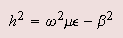
If we define a parameter  (transverse propagation constant) as (transverse propagation constant) as |
|
 |
|
|
we can write transverse electric and magnetic field in term of the longitudinal field components ( , ) as |
|
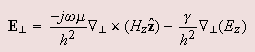 |
----------- (6.28 ) |
|
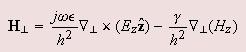 |
----------- (6.29 ) |
|
Here  transverse is defined by transverse is defined by |
|
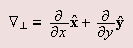 |
----------- (6.30 ) |
|
in Cartesians co-ordinate system. |
|
|
|
From the above equations we can make some important observations as follows : |
|
(1) |
Transverse fields can exist provided at least one of the longitudinal components ( or or  ) is non-zero,
except when ) is non-zero,
except when  = 0. That is, in general there is no transverse electromagnetic wave propagation except when = 0. That is, in general there is no transverse electromagnetic wave propagation except when  . . |
|
(2) |
For  we get we get  implying that the transverse electromagnetic wave can exist in a waveguide
if its propagation constant is same as that of the unbound medium filling the waveguide. implying that the transverse electromagnetic wave can exist in a waveguide
if its propagation constant is same as that of the unbound medium filling the waveguide. |
|
(3) |
The fields corresponding to  , have electric field transverse to the direction of wave propagation
and hence represent the Transverse electric (TE) wave. , have electric field transverse to the direction of wave propagation
and hence represent the Transverse electric (TE) wave. |
|
(4) |
The fields corresponding to  =0 have magnetic field transverse to the direction of wave propagation
and hence represent Transverse magnetic (TM) wave. =0 have magnetic field transverse to the direction of wave propagation
and hence represent Transverse magnetic (TM) wave. |
|
(5) |
For TM or TE case,  or or  respectively is to be non zero, and respectively is to be non zero, and  has to be non zero. Otherwise the transverse
fields would become infinite. In other words, the TE and TM modes can not have the phase constant same
as that of the unbound medium. The TE and TM modes then essentially have to be dispersive modes
i.e., their phase velocity should vary as a function of frequency. has to be non zero. Otherwise the transverse
fields would become infinite. In other words, the TE and TM modes can not have the phase constant same
as that of the unbound medium. The TE and TM modes then essentially have to be dispersive modes
i.e., their phase velocity should vary as a function of frequency. |
|
|
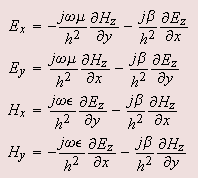
In Cartesian co-ordinate system we can explicitly write the transverse field component in terms of the longitudinal components as |
|
 |
|
| ----------- (6.31) |
| |
| ----------- (6.32) |
| |
| ----------- (6.33) |
| |
| |
| ----------- (6.34) |
| |
|
So, in the analysis of a wave guide first we obtain or which is consistent with the boundary conditions and then |
|
subsequently obtain the transverse component using the above equation. |
|


