| |
|
|
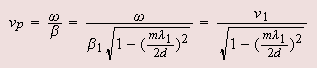
The phase velocity of a mode is |
| |
|
|
|
 |
---------- (6.25) |
|
where  is the velocity of the uniform plane wave in the medium filling the region between the wave guide walls. is the velocity of the uniform plane wave in the medium filling the region between the wave guide walls. |
|
|
|
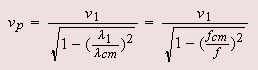
Noting that  the phase velocity can be written as the phase velocity can be written as |
| |
|
|
|
 |
---------- (6.26) |
|
|
|
It is clear from the expression that in general the phase velocity of a mode is a function of frequency except when the cut-off frequency is zero. This phenomena is called ' WAVE DISPERSION'. |
| |
|
|
In general, one can then say that the modal propagation on a wave guide is dispersive in nature. |
|
|
|
The group velocity of the mode is |
|
 |
---------- (6.27) |
|
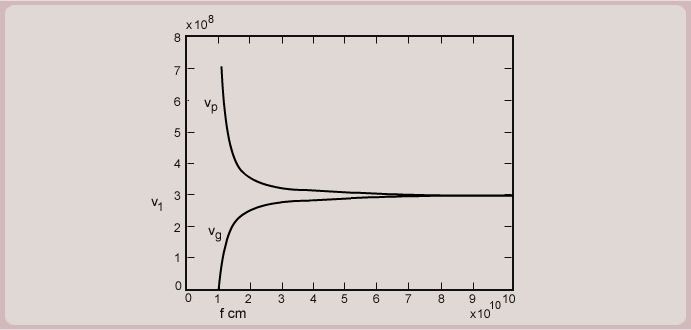
Typical plot for group and phase velocities is shown in figure below |
|
|
|
|
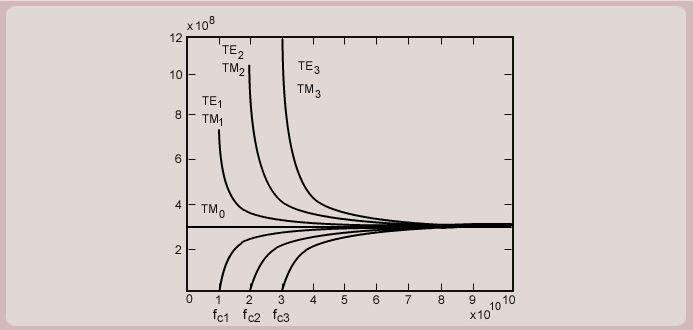
At the cut-off frequency the phase velocity approaches infinity whereas the group velocity approaches zero. That means the energy propagation seizes as the mode approaches cut-off. As the frequency increases both group and phase velocities asymptotically approach the velocity of the plane wave in the media. |
|
|
|
The figure below shows the typical velocity plot for different modes as a function of frequency. |
|
|