| |
Cut-off Frequency of a Mode |
|
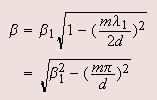
The propagation constant of the modal fields in the  -direction is given as -direction is given as |
|
 |
---------- (6.17) |
| |
| ---------- (6.18) |
| |
|
|
|
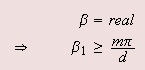
If the propagation constant  is real the mode will be at travelling mode whereas, if becomes imaginary the wave exponentially decays in the -direction and the fields do not represent a wave. These fields are then called 'EVANASENT FIELDS' . The evanasent fields do not carry any power. The power is carried only by the travelling modes. is real the mode will be at travelling mode whereas, if becomes imaginary the wave exponentially decays in the -direction and the fields do not represent a wave. These fields are then called 'EVANASENT FIELDS' . The evanasent fields do not carry any power. The power is carried only by the travelling modes. |
|
|
|
For the travelling mode therefore we need to be real which implies |
| |
|
---------- (6.19) |
|
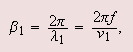
Since |
|
 |
---------- (6.20) |
|
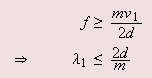
where  is the velocity of the uniform plane wave in medium 1, we get is the velocity of the uniform plane wave in medium 1, we get |
|
 |
|
| ---------- (6.21) |
| ---------- (6.22) |
| |
|
|
We can note the following important things at this stage: |
|
|
(1) |
For a given waveguide height  , the frequency has to be higher than certain threshold frequency for propagation of a particular mode. The threshold frequency is called CUT-OFF freuquency at the mode and given by , the frequency has to be higher than certain threshold frequency for propagation of a particular mode. The threshold frequency is called CUT-OFF freuquency at the mode and given by |
|
|
|
|
---------- (6.23) |
| |
|
The corresponding cut-off wavelength is |
|
 |
---------- (6.24) |
|
|
(2) |
For a given waveguide height,  , and frequency, , and frequency,  , only those modes propagate for which , only those modes propagate for which  . . |
|
This means inside a wave guide there is a possibility of only finite number of modes at a given frequency. |
|
|
(3) |
As the mode number (  ) increases and the cut-off frequency also increases meaning higher order mode get excited only at higher frequencies. ) increases and the cut-off frequency also increases meaning higher order mode get excited only at higher frequencies. |
|
|
|
The cut-off frequencies for different modes are shown in the following figure: |
|
|
|
|
If a mode has the cut-off frequency less than the frequency of operation the mode propagates otherwise it does not propagate. |
|
|
NOTE : |
|
The  mode which is also the TEM mode has no cut-off frequency. This is the mode which can propagate at any frequencies starting from mode which is also the TEM mode has no cut-off frequency. This is the mode which can propagate at any frequencies starting from  . . |
|




.jpg)


