Without losing generality, let us assume that the electric field due to individual antennas has unit amplitude at the observation point P. Also let the first element be the reference element. Then by definition the phase of the field due to antenna 1 is zero. |


 , between the fields due to adjacent elements is algebraic sum of the current and the propagation phase difference.




 ). The maximum filed therefore is N.
  , and hence is the radiation pattern of the antenna array.
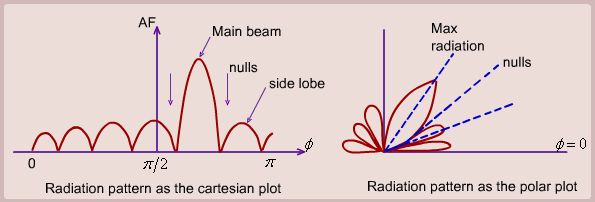
 is from 0 to
  , and the 3-D radiation pattern is the figure of revolution of the Array Factor around the axis of the array.
