Module 7 : Antenna
Lecture 51: Antenna Arrays


Uniform Linear Array

An antenna array consists of identical antenna elements with identical orientation distributed in space. The individual antennas radiate and their radiation is coherently added in space to form the antenna beam.
   

For a linear array, the antennas are placed along a line called the Axis of the array. The antenna elements in general could have arbitrary spacing between them and could be excited with different complex currents. However, here we analyze first the uniform array.


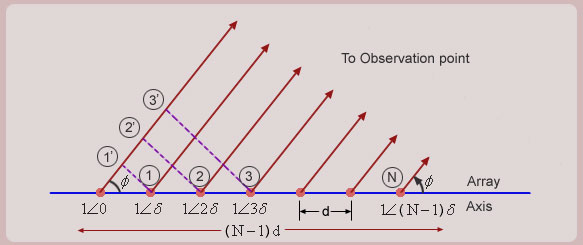
In a uniform array the antennas are equi-spaced and are excited with uniform current with constant progressive phase shift (phase shift between adjacent antenna elements) as shown in Fig.


Let the array have N elements and let the antennas be isotropic (this condition will be relaxed later). All the antennas are excited with equal amplitude currents. Let us define the following for the array.


Inter-element spacing, : This the spacing between any two adjacent elements of the array.


Progressive phase-shift, : This is the phase shift between currents on any two adjacent antenna elements of the array.


The field due an antenna is proportional to its current. Also for a far away point, the fields due to individual antennas have equal amplitude but different phases.


The phase of the field has two components:

    (1)  The phase due to the phase of the excitation current.

    (2)  The phase due to propagation. If the observation point P is in a direction which makes an angle with the array axis,            the propagation phase difference between radiation from two adjacent elements is .