The unit impulse (discrete time):
How do we go on with studying the responses of systems to various signals? It would be great if we can study the response of the system to one (or a few) signal(s) and predict the responses to all signals. It turns out that LSI systems
can in fact be treated in such manner. The signal whose response
we study is the unit impulse signal. If we know the response of the system to the unit impulse (called, for obvious reasons, the unit impulse response), then the system is completely
characterized - we can find the response of the system to all possible inputs. This follows rather intuitively in discrete signals, so let us begin our analysis with discrete signals. In discrete signals, the unit impulse is a signal which has zero values everywhere except at one point, where its values is 1. Typically, this point is taken to be the origin (n=0).
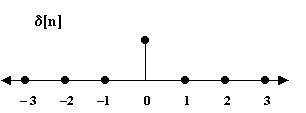
The unit impulse is denoted by the
Greek letter delta . For example, the above impulses are denoted by
 and and
 respectively. respectively.
Note: We are towards invoking shift invariance of the system here - we have shifted the signal
by 4 units.
We can thus use
to pick up a certain point from a discrete signal: suppose our signal x[n] is multiplied by then the value of then the value of
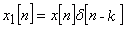 is zero at all point except n=k. At this point, the value of x1[k] equals the value x[k]. is zero at all point except n=k. At this point, the value of x1[k] equals the value x[k].
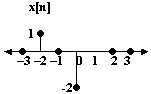 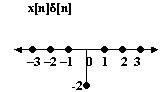 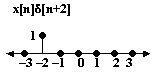
Now, we can express any discrete signal as a sum of several such terms:

This may seem redundant now, but later we shall find this notation useful when we take a look at convolutions etc. Here, we also want to introduce a convention for denoting discrete signals. For example, the signal x[n] and its representation are shown below :
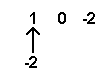
The number below the arrow shows the starting point of the time sequence, and the numbers above are the values of the dependent variable at successive instants from then onwards. We may not use this too much on the web site, but this turns out to be a convenient notation on paper.  |


