Analogy from discrete domain
We will see that the impulse function is defined by its sampling property. We shall develop the theory by drawing analogy from the Discrete Time domain. Consider the equation
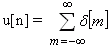 The discrete time unit step function is a running sum of the delta function. The continuous time unit impulse and unit step function are then related by
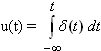 The continuous time unit step function is a running integral of the delta function. It follows that the continuous time unit impulse can be thought of as the derivative of the continuous time unit step function.

Now here arises the difficulty. The unit Step function is not differentiable at the origin. We take a different approach. Consider the signal whose value increases from 0 to 1 in a short interval of time say delta. The function u(t) can be seen as the limit of the above signal as delta tends to 0. Given this definition of Unit Step function we look into its derivative. The unit impulse function can be regarded as a rectangular pulse with a width of
 and height (1 /
). As
tends to 0 the function approaches the Unit Impulse function and its derivative becomes narrower and higher and eventually a pulse of infinitesimal width of infinite height. All throughout the area under the pulse is maintained at unity no matter the value of
. In effect the delta function has no duration but unit area. Graphically the function is denoted as spear like symbol at t = 0 and the "1" next to the arrow indicates the area of the impulse. After this discussion we have still not cleared the ambiguity regarding the value or the shape of the Unit Impulse Function at t = 0. We were only able to derive that the the effective duration of the pulse approaches zero while maintaining its area at unity. As we said earlier an Impulse Function is a Generalized Function and is defined by its effect on other functions and not by its value at every instant of time. Consider the product of an impulse function and a more well behaved continuous function. We will take the impulse function as the limiting case of a rectangular pulse of width
and height (1/) as earlier. As evident from the figure the product function is 0 everywhere except in the small interval. In this interval the value of x(t) can be assumed to be constant and equal to x(0). Thus the product function is equal to the function scaled by a value equal to x(0). Now as
tends to 0 the product tends to x(0) times the impulse function. and height (1 /
). As
tends to 0 the function approaches the Unit Impulse function and its derivative becomes narrower and higher and eventually a pulse of infinitesimal width of infinite height. All throughout the area under the pulse is maintained at unity no matter the value of
. In effect the delta function has no duration but unit area. Graphically the function is denoted as spear like symbol at t = 0 and the "1" next to the arrow indicates the area of the impulse. After this discussion we have still not cleared the ambiguity regarding the value or the shape of the Unit Impulse Function at t = 0. We were only able to derive that the the effective duration of the pulse approaches zero while maintaining its area at unity. As we said earlier an Impulse Function is a Generalized Function and is defined by its effect on other functions and not by its value at every instant of time. Consider the product of an impulse function and a more well behaved continuous function. We will take the impulse function as the limiting case of a rectangular pulse of width
and height (1/) as earlier. As evident from the figure the product function is 0 everywhere except in the small interval. In this interval the value of x(t) can be assumed to be constant and equal to x(0). Thus the product function is equal to the function scaled by a value equal to x(0). Now as
tends to 0 the product tends to x(0) times the impulse function.
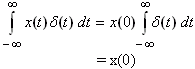
i.e. The area under the product of the signal and the unit impulse function is equal to the value of the signal at the point of impulse. This is called the Sampling Property of the Delta function and defines the impulse function in the generalized function approach. As in discrete time
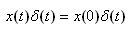
Or
more generally,

Also the product x(t)u(t) truncates the signal for t < 0. |


