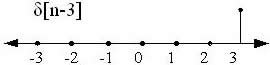
Consider any discrete time signal x[n].
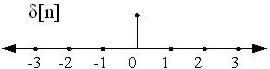
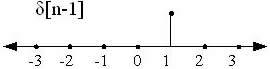
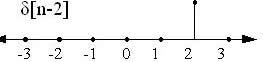
It is intuitive to see how the
signal x[n] can be represented as sum of many
delayed/advanced and scaled Unit Impulse Signals.
Mathematically, the above function can be represented as
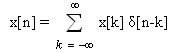
More generally any discrete time signal
x[n] can be represented as
The above expression corresponds to the representation of any arbitrary sequence as a linear combination of shifted Unit Impulses
which are scaled by
x[n].
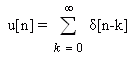
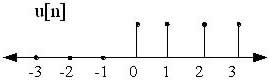
Consider for example the Unit Step function. As shown
earlier it can be represented as
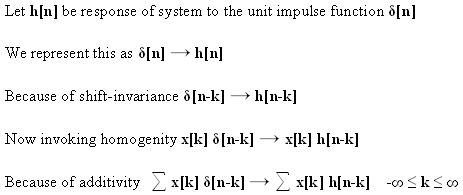
Now if we knew the response of a system for a Unit Impulse Function, we can obtain the response of any arbitrary input. To see why this is so, we invoke the properties of Linearity, Homogeneity ( Superposition ) and Time Invariance.
The left hand side can be identified as any arbitrary input, while the right hand side can be identified as the total output to the signal. The total response of the system is referred to as the CONVOLUTION SUM or superposition sum of the sequences
x[n] and h[n]. The result is more concisely stated as
y[n] = x[n] * h[n], where
Therefore, as we said earlier a LTI system is completely characterized by its response to a single signal i.e. response to the Unit Impulse signal.


 which are scaled by
x[n].
Consider for example the Unit Step function. As shown
earlier it can be represented as
which are scaled by
x[n].
Consider for example the Unit Step function. As shown
earlier it can be represented as