Module 4 : Laplace and Z Transform
Lecture 30 : Laplace Transform

Definition of Laplace transform:

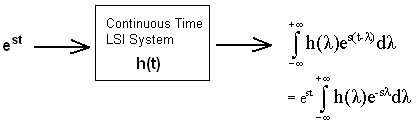
The response of a Linear Time Invariant system with impulse response h(t) to a complex exponential input of the form est can be represented in the following way :

Let

Where  H(s) is known as the Laplace Transform of h(t). We notice  that the limits are from [-∞ to  +∞] and hence this transform is also referred to as Bilateral or Double sided Laplace Transform. There exists a one-to-one correspondence between the h(t) and H(s)  i.e. the original domain and the transformed domain. Therefore L.T. is a unique transformation and the 'Inverse Laplace Transform' also exists.

Note that 
est  is also an eigen function of the LSI system only if  H(s) converges. The range of values for which the expression described above is finite is called as the Region of Convergence (ROC). In this case, the  region of convergence is Re(s) > 0.

Thus,  the Laplace transform has two parts which are , the expression and region of convergence  respectively. The region of convergence of the Laplace transform is essentially determined by Re(s). Here onwards we will consider trivial examples for a better understanding of the ROC.