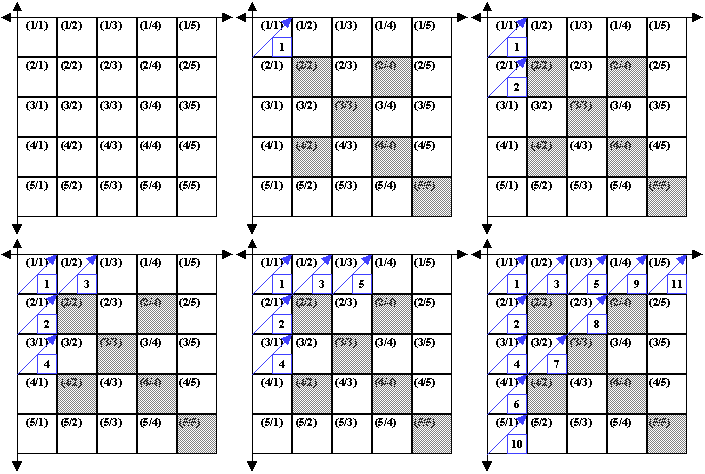
Now lets come to something that is discrete alright, but not very intuitive about how we can index it - rational numbers:
We represent the rational numbers along the fourth quadrant, as y/x. The repeated areas (like 2/2, 3/3, 4/2 etc) are to be neglected, hence are in gray. Then we go on indexing them diagonally as shown by the animation. Now, we go ahead another step - how do we index a full plane?
Note the method: we start in expanding circles from the origin. As soon as a circle cuts integer points, we pause and number the points clockwise from the positive y axis. This method is by no means unique - but just one set of indexing is enough for us to call the system “discrete”. Here we pause to note that although variables like the integer plane above can be indexed by integers, it is far more convenient to use tuples of integers to index them. It can mathematically be proved that any finite set of integers {a
1 , a 2 , a 3 .... a
n } can be indexed by a single variable. We leave out the proof here, but the interested reader can find it in books on number theory.