|
What is a signal?
A signal, as stated before is a function of one or more independent variables. Recall that a function defines a correspondence between 2 sets, i.e.: corresponding to each element of one set (called the
domain ), there exists a unique element of another set (called the
co-domain ) .
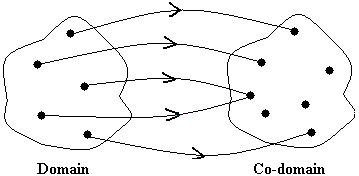
Notice that more than one element in the domain may correspond to the same element in the co-domain .
A function is also sometimes referred to as a mapping. Thus a signal may also be defined as a mapping from one set to another.
For example a speech signal would be mathematically represented by acoustic pressure as a function of time. Some more examples of signals are voltage, current or power as functions of time. A monochromatic picture can be described as a signal which is mathematically represented by brightness as a function of two spatial variables.
As mentioned earlier, there may be more than one independent variable. For example, the independent variable for a photograph is 2-dimensional space (2 space variables). The variables may also be hybrid, say 2 space variables and 1 time variable (E.g.: a video signal).
Note: In this course, we shall focus our attention on signals of only one variable. Also, for convenience, we shall generally refer to the independent variable as time. So don't let the recurring reference to time confuse you. It is symbolic for any independent variable you care to choose.
|


