|
Convolution between a periodic and an aperiodic signal
We now apply the Convolution theorem to the special case of
convolution between a periodic and an aperiodic signal. (Note convolutions between periodic signals do not converge, we'll address that issue after this.)
Recall: If a periodic signal x(t)
with period
T obeys the Dirichlet conditions for a Fourier Series representation,
then,
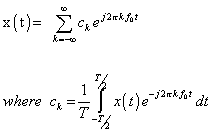
and its Fourier Transform is given by
 If the convolution between x(t) and some Fourier Transformable aperiodic signal h(t) converges, lets see what the Fourier transform of x*h looks like (assuming it exists). Note x*h is also periodic with the same period as x(t) and its Fourier transform is also then expected to be a train of impulses. By the convolution theorem, the Fourier Transform of x*h is:
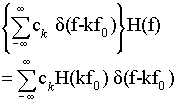 implying, the implying, the  Fourier series co-efficient of x*h is Fourier series co-efficient of x*h is  . .
Therefore, assuming a periodic signal x(t) has a Fourier series representation, and an aperiodic signal h(t) is Fourier transformable, if x*h converges (and has a Fourier series representation), it is periodic with the same period as x(t) and its Fourier series coefficients are the Fourier series coefficients of x(t) multiplied by the value of H(f) at that multiple of the fundamental frequency.

|


