|
The Convolution Theorem
We shall in this lecture prove the most important theorem regarding the Fourier Transform- the Convolution Theorem. It is this theorem that links the Fourier Transform to LSI systems, and opens up a wide range of applications for the Fourier Transform. We shall inspire its importance with an application example.
Modulation
Modulation refers to the process of embedding an information-bearing signal into a second carrier signal. Extracting the information-bearing signal is called demodulation. Modulation allows us to transmit information signals efficiently. It also makes possible the simultaneous transmission of more than one signal with overlapping spectra over the same channel. That is why we can have so many channels being broadcast on radio at the same time which would have been impossible without modulation
There are several ways in which modulation is done. One technique is amplitude modulation or AM in which the information signal is used to modulate the amplitude of the carrier signal. Another important technique is frequency modulation or FM, in which the information signal is used to vary the frequency of the carrier signal. Let us consider a very simple example of AM.
Consider the signal x(t) which has the spectrum
X(f) as shown :
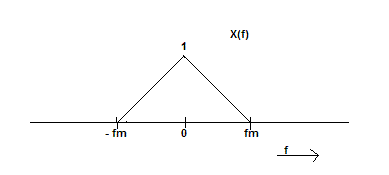
Why such a spectrum ? Because it's the simplest possible multi-valued function. Also, it is band-limited (i.e.: the spectrum is non-zero in only a finite interval of the frequency axis),
having a maximum frequency component fm . Band-limited signals will be of interest to us later on.

|


