
a) Discrete time :
 {
By Commutative Property }
{
By Commutative Property }
In order for a discrete LTI system to be causal, y[n] must not depend on x[k] for k > n. For this to be true h[n-k]'s corresponding to the x[k]'s for k > n must be zero. This then requires the impulse response of a causal discrete time LTI system satisfy the following conditions :

Essentially the system output depends only on the past and the present values of the input.
Proof : ( By contradiction )
Let in particular h[k] is not equal to 0, for some k<0
 {Refer
the eqn. above}
{Refer
the eqn. above}
So we need to prove that for all x[n] = 0, n < 0, y[0] = 0

Now we take a signal defined as

This signal is zero elsewhere. Therefore we get the following result :
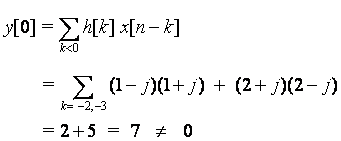
We
have come to the result that y[0]
 0, for the above
assumption.
0, for the above
assumption.  our assumption stands void. So
we conclude that y[n]
cannot be independent of x[k]
unless h[k]
= 0 for k < 0
our assumption stands void. So
we conclude that y[n]
cannot be independent of x[k]
unless h[k]
= 0 for k < 0
Note : Here we ensured a non-zero summation by choosing x[n-k]'s as conjugate of h[k]'s.


