
.gif) ,
there are two choices
,
there are two choiceslaplace_page5.gif)
 ,
the only possible option is
,
the only possible option is  ( to have a non-empty ROC).
_pege_6.gif)
laplace_page6.gif)
As Re{s}
= 0 lies in ROC , we will
have to take to be the inverse.
Thus, in a rational system, with ROC of the system function including Re(s)=0, the poles to the left of imaginary axis contribute right-sided exponentially decaying term and poles to the right of the imaginary axis contribute left-sided exponentially decaying term.
|
α
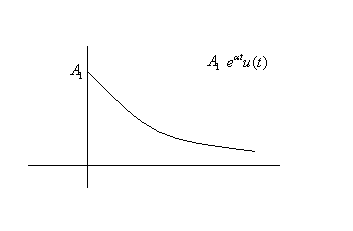
contributes a right-sided decaying exponential
|
β
contributes a left handed decaying exponent.
|
 |
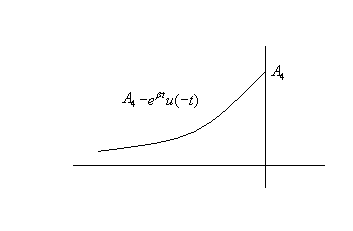 |
Poles to the right of imaginary axis contribute -Pβ(t)eβtu(-t), where Pβ(t) is a polynomial of degree k-1
k = order of pole at  in H(s)
Similarly poles to the left of imaginary axis contribute Pα(t)eαtu(t)
The absolute
integral _page%207.gif)
integral_page7.gif)
Thus the
absolute integral with%20less%20than%20sign_page%207.gif) sum of the absolute integrals of these terms (finite
number because the system function is rational)
sum of the absolute integrals of these terms (finite
number because the system function is rational)

Therefore, the system is stable.
Later,
we shall prove the theorem ,that
irrespective of the polynomial p(t),
_page%208.gif) converges
if and only if
converges
if and only if _page%208.gif) converges, in order to justify the convergence
of each absolute integral.
converges, in order to justify the convergence
of each absolute integral.


