|
Gibb's
Phenomenon
We can approximate a signal having a Fourier Series expansion by taking a finite number
of terms of the expansion.
i.e: 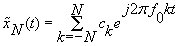 is an approximation to the periodic signal
x(t). is an approximation to the periodic signal
x(t).
 is also called a Partial Sum. We would obviously expect that as the number
of terms
taken
is increased, this summation would become a better and better approximation to
x(t), i.e would approach x(t) uniformly. is also called a Partial Sum. We would obviously expect that as the number
of terms
taken
is increased, this summation would become a better and better approximation to
x(t), i.e would approach x(t) uniformly.
Indeed this happens in regions of continuity of the original signal. However,
at the points of discontinuity in the original signal, an interesting phenomenon
is observed. The partial sum oscillates near the point of discontinuity.
We might expect these oscillations to decrease as the number of terms taken
is
increased. But surprisingly, as the number of terms taken is increased, although
these oscillations get closer and closer to the point of discontinuity, their
amplitude does not decrease to zero, but tends to a non zero limit. This phenomenon
is known as the Gibb's Phenomenon, after the
mathematician who accounted for these oscillations.
The illustration below shows the various Fourier approximations of a periodic square wave.
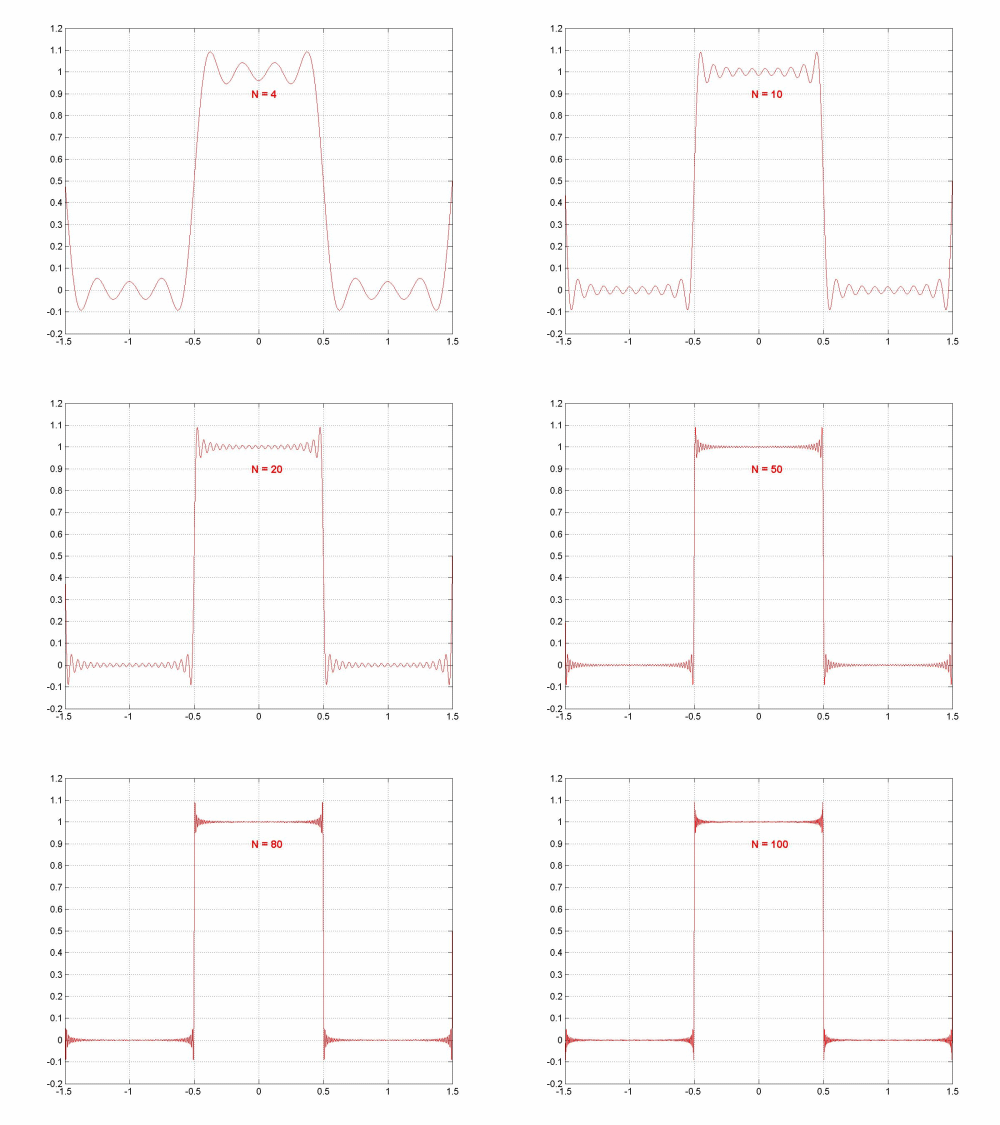
Mathematically, this means if the periodic signal has discontinuities, its Fourier Series does not converge uniformly.

|


