Dirichlet Conditions For Pointwise Convergence
Consider the following 3 conditions that may be imposed on a periodic signal
x(t) :
1) x(t) should be absolutely integrable over a period. A signal that does not satisfy this condition is
x(t) = tan(t)
as:- 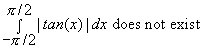
2) x(t) should have only a finite
number of discontinuities over one period. Furthermore, each of these discontinuities
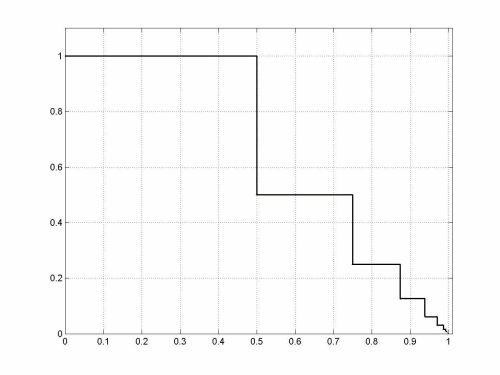
must be finite. An example of a function which has infinite number of discontinuities is illustrated below. The function is shown over one of the periods.
3) The signal x(t) should have only a finite number of maxima and minima in one period. An example of a function which has infinite number of maxima and minima is: a periodic signal with period 1, defined on (0,1] as:  . .
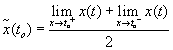
If the signal satisfies the above conditions, then at all points where the signal is continuous, the Fourier Series converges to the signal. However, at points where the signal is discontinuous (Dirichlet conditions allow finite number of discontinuities in a period), the Fourier Series converges to the average of the left and the right hand limits of the signal. Mathematically, at a point of discontinuity  , ,
In practice, the restrictions imposed on signals by
the Dirichlet conditions are not very severe, and most of the signals we will deal with satisfy these conditions.  |


