| |
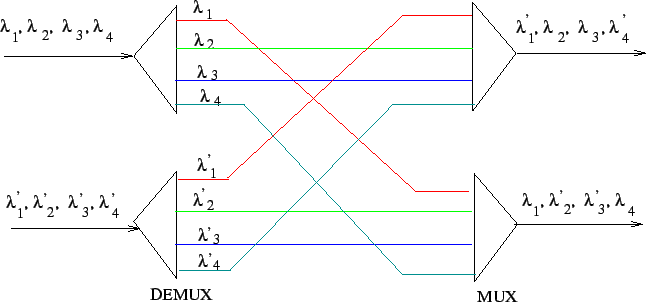
We may think of the matrix as one whose columns represent input ports and the rows the output ports. Exactly one wavelength (as indicated by different colour in the table) from each input port will be routed to each output port. The wavelength used by the router from port  to port to port  is given by the colour scheme of the is given by the colour scheme of the  element of the table. Note that if two signals of the same wavelength arrive at two different ports, they will be directed to two distinct output ports. For instance, if the scheduling is done by the left hand side figure in which the same wavelength (blue) arrive at both input port 1 as well as 2, the former will be routed to output port 1 and the latter to 2. The same physical wavelength being used for different I-O connection is known as wavelength re-use . The figure shows a typical static wavelength router. element of the table. Note that if two signals of the same wavelength arrive at two different ports, they will be directed to two distinct output ports. For instance, if the scheduling is done by the left hand side figure in which the same wavelength (blue) arrive at both input port 1 as well as 2, the former will be routed to output port 1 and the latter to 2. The same physical wavelength being used for different I-O connection is known as wavelength re-use . The figure shows a typical static wavelength router. |
| |
 |
| |
If the network condition changes frequently, a static routing is not helpful. One needs to then use dynamic switching of wavelength. In the following figure, two WDM rings are connected to a wide area network. Each ring can transmit in two wavelengths  and and  . Problem arises if the node A of the left LAN wishes to communicate with the node B of the right LAN. As the wavelength . Problem arises if the node A of the left LAN wishes to communicate with the node B of the right LAN. As the wavelength  at which node A transmits is in active use in another channel of the right LAN, a dynamic at which node A transmits is in active use in another channel of the right LAN, a dynamic |
|


