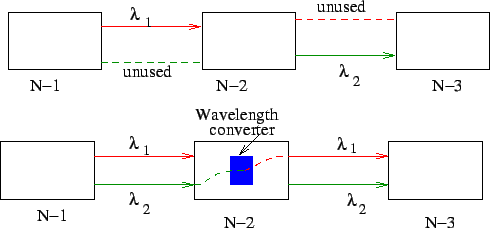
As only two wavelength are available, it is not possible to establish a light path between N-1 and N-3 (without violating continuity condition) though there is a free wavelength between each of the segments. However, if a wavelength converter is located at the node N-2, we may relax the continuity condition, as shown in the right hand figure.
The degree of wavelength conversion used in a given network depends on the traffic pattern in the network. The figure below illustrates different situations for a single input port and a single output port. |

 and
and  are available. There is one light path between N-1 and N-2 and a second light path between N-2 and N-3, the former using the wavelength
  and the latter
  .
.