| |
|
| |
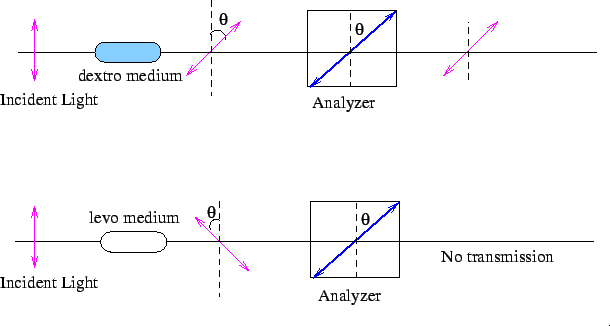
After passing through the polarizer, suppose the electric vector is in the x-y plane, making an angle  with the x-axis. If now, the transmitted light is made to pass through an analyzer whose axis is parallel to the direction of the rotated electric vector, the polarized light would pass through such an analyzer. However, if the light were to enter the optically active medium from the opposite direction, the optical rotation will be with the x-axis. If now, the transmitted light is made to pass through an analyzer whose axis is parallel to the direction of the rotated electric vector, the polarized light would pass through such an analyzer. However, if the light were to enter the optically active medium from the opposite direction, the optical rotation will be  . If the transmitted light enters the analyzer with axis same as before, no light would pass through as the direction of polarization and the axis of analyzer are at right angles to each other. . If the transmitted light enters the analyzer with axis same as before, no light would pass through as the direction of polarization and the axis of analyzer are at right angles to each other.
Thus, using a combination of an optically active substance and analyzer (and in some cases, by application of a magnetic field), one can design such that light travels primarily in one direction, cutting off light travelling in the opposite direction by as much as 40 dB. A primary disadvantage associated with this is that since the incident light is not polarized to begin with, the polarizer reduces the incident intensity by a factor of two, causing a 3 dB loss. This loss can be eliminated by a complicated wich uses a beam splitter and an acousto-optic filter. Optical isolation is the ratio of the transmitted power in the desired direction to that in other directions. In ideal situation, the insertion loss should be zero while the optical isolation should be infinite. Isolators are designed using polarizers, acousto-optic filters and beam splitters. |
|