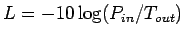
A multiplexer should have low insertion loss and should not allow back scattering of light to any of the input ports. Insertion loss is the attenuation in the signal in travelling from the input port to the output port. It is defined as .
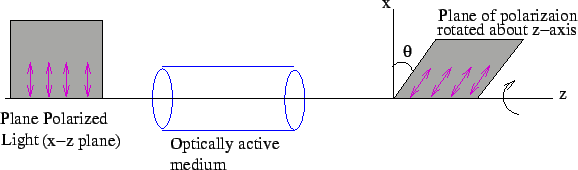
Back reflection can be avoided by use of optical isolators , which allow light to propagate only in one direction, similar to a diode in an electronic circuit which allow current in one direction. A typical optical isolator has an insertion loss less than 1 dB and high return loss greater than 40 dB. This is achieved by using the property of optical activity. When a beam of linearly polarized light is passed through an optically active medium, the transmitted light is also plane polarized. However, the plane of polarization is rotated about the direction of propagation. If an observer looks towards the source parallel to the direction of propagation, the plane of polarization would rotate either clockwise (towards observer's right) or anticlockwise (towards left). The optically active substance is known respectively as dextrorotatory or as levorotatory.
By suitably adjusting the length of the optically active substance through which light travels, one can control the angle of rotation .
Consider the incident light to be plane polarized in the x-z plane (z is the direction of propagation, x the direction of electric vector ).

 .
. 
 .
.  ).
). 
