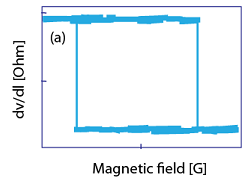
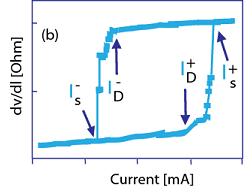
Figure 23.2: (a) Switching of the magnetic layers in a nanopillar device by a magnetic field at 4.2 K. (b) Switching in the same device by spin-transfer torques from an applied current at 4.2 K.
Starting from the lower-resistance P state, a sufficiently large positive current causes a jump to higher-resistance AP state. By our sign convention (as discussed earlier), positive currents correspond to electron flow from the free layer to the fixed layer, the sign of current predicted within the spin-transfer theory to destabilize the P configuration and stabilize the AP one. Once the magnets are in the high-resistance AP configuration, they can be switched back to the P orientation by applying a sufficiently large negative current [4].
The switching between the P and AP states can be identified with the mechanism of the spin-transfer torques, rather than current-induced magnetic fields. The fact that in nanometer scale devices the current levels are too small to produce magnetic fields of the magnitude needed to switch the magnets. Note that the differential resistance exhibits small peaks or shoulders starting at the currents  and
and  , prior to the large jumps in resistance [8]. This is due to the turn-on of a dynamical state in which the free layer undergoes small-angle precession. At low temperature, spin transfer excites the free layer into a precessional mode first, before eventually reversing the moment to reach a final static state AP to the fixed layer moment.
Possible applications of spin transfer torques:
(a) Magnetic random access memory:
The ability of the spin-transfer effect to produce controllable switching of two magnetic layers back and forth between a high-resistance AP state and a low-resistance P state suggests that spin transfer might be a useful mechanism for writing information within non-volatile magnetic random access memories. Spin-transfer switching is more efficient than the alternative of using current-generated magnetic fields to control magnetic bits. Furthermore, spin-transfer has a number of other potential advantages relative to field switching: