Patterned media :
One of the important advantages of conventional magnetic recording over other recordings, such as dynamic random access memory (DRAM) and flash, is the use of a continuous featureless recording medium using the magnetic heads fabricated through the lithography techniques.
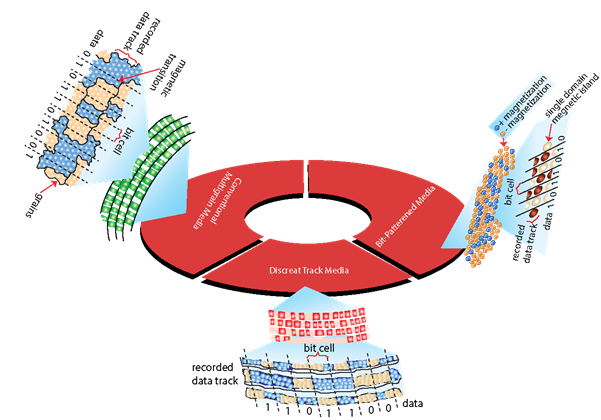
However, to push the recording densities beyond the limit of conventional continuous granular media, two forms of lithographically patterned media have been proposed: discrete (or patterned) track media and bit patterned media, as shown in Figure 40.5. For example, the areal density of 520 Gigabits/inch2 requires the bit dimensions of 15 nm (spacing between the transitions) x 81 nm (track pitch). The ratio between the later one to earlier one is called as bit aspect ratio, which is 5.4 for the above case. While the track pitch is limited by lithography process, the spacing between the transitions are not limited by rather the thin film deposition processes used to produce the read and write head elements. Nevertheless, we need to understand that what kind of advantages a nanofabrication of media would bring compare to the continuous unstructured media which is quite in-expensive.
|
Figure 40.5: Schematic drawing of the continuous drawing bits, discrete track bits, and patterned media bits. |
References:
[1]. A. Perumal, L. Zhang, Y.K. Takahashi, and K. Hono, J. Appl. Phys. 108 (2010) 083907.
[2]. L. Zhang, A. Perumal, Y.K. Takahashi, and K. Hono, J. Magn. Magn. Mater. 322 (2010) 2658.
[3]. S. Batra et al, IEEE Trans Magn 42 (2006) 2417.
[4]. J. G. Zhu, X. C. Zhu, and Y. H. Tang, IEEE Trans. Magn. 44 (2008) 125.