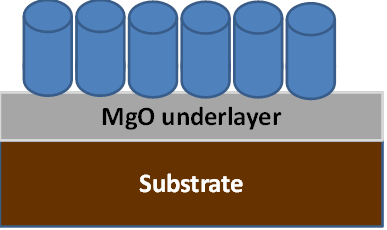
Recently, FePtAgC based alloy films with nanogranular microstructure were considered as one of the promising materials for high density magnetic recording using perpendicular magnetic recording scheme [1,2]. T he advantages of the perpendicular recording system over the longitudinal recording are manifold: (i) a very high thermal stability can be achieved even in small grain (with diameter along in-plane direction) with cylindrical grain structure (along normal to the film plane direction), as shown in Figure 40.1, (ii) The single pole head in a recording media with a soft underlayer can generate twice the field of longitudinal recording head (see Lecture 30). This allows one to write a medium with higher coercivity, further decreasing grain size and maintaining media thermal stability. (iii) The read-back signal from perpendicular medium with soft underlayer is larger as compared with equivalent longitudinal medium, improving signal-to-noise ratio, (iv) Commonly, the perpendicular media grains are strongly oriented, which results in smaller medium noise and a sharper recorded transition. (v) Also, the demagnetization field in the perpendicular medium is small at the transition region. This allows writing narrower magnetic transitions and improves thermal stability of high density data.
|
Figure 40.1: Schematic drawing of arrangements of FePt based alloys grains perpendicular magnetic recording media. |
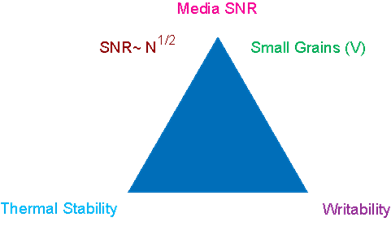
It is important to highlight that the introduction of perpendicular recording technology postpones the superparamagnetic problem. However, this solution can only delay the problem for short duration. On the other hand, clearly, a reduction in the grain size can be compensated for by an increase in the magnetocrystalline anisotropy constant. This results in an increase in the anisotropy field of the medium, as given by,  and increases the medium coercivity. Therefore, one needs a larger write fields. Unfortunately, the maximum field of the writing heads is limited in the current technology and this poses a huge difficulty to the use of magnetic materials with high anisotropy fields. This establishes a well-known magnetic recording trilemma (see Figure 40.2).
|
Figure 40.2: Schematic drawing of the magnetic recording trilemma. |
|
Figure 40.3: Temperature dependent perpendicular coercivity for a ferromagnetic material. |
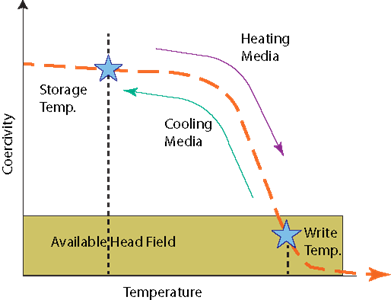
Currently, various research teams in industry and academia are actively involved in searching new solutions for the future. Two types of approaches have been proposed to push the areal densities above Terabits/inch2 . In the first type, an additional source of energy is needed to assist the applied magnetic field in reversing the bit magnetization, thus allowing higher anisotropy media to be used. These additional energies can either be provided by both heat-based processes, where locally heating the bit [3] and lower the anisotropy during writing or by adding a radio-frequency magnetic field [4]. The second type of approaches involves the use of lithographically patterned media, which has the advantage that the head designs similar to those in production today can still be used, but with radically different media. In the following, we shall discuss both of these suggested methods.