Introduction:
Anisotropy plays an important role in understanding the nature of magnetic hysteresis loop for a given material. It refers to the fact that when no magnetic field is applied to a given magnetic material, the direction of magnetization prefers to point in a certain direction called easy axis. Figure 3.1 shows a typical situation where for zero applied field, the magnetization M would point along the easy axis shown (α = 0). When a field H is applied, the magnetization is pulled towards the field direction. As the field is increased, the magnetization points closer to the field direction. For any intermediate values of α, the magnetization is being attracted in opposite directions, i.e., up by the field H and down by the anisotropy.
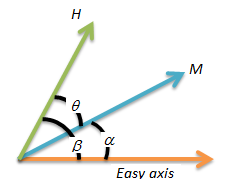
Figure 3.1: Schematic drawing of magnetization, applied field and easy axis for a material.
Let us assume that all the magnetization is pointing in the same direction in a magnetic material, and the material exhibits an easy axis of magnetization. In such scenario, we can describe the energy per unit volume of the magnetization of this material by
|
(3.1) |

where K is called the anisotropy constant with an unit of energy per unit volume (J/m3). Hence, the energy term, E , is also energy per unit volume. In general, the magnitude of uniaxial anisotropy is described in terms of the anisotropy field, which is defined as the field needed to saturate the magnetization of a uniaxial crystal in the hard axis direction, as given in eqn.(3.2)
|
(3.2) |

In general, the energy of the magnetization is given by,
|
(3.3) |

where, the first term is anisotropy energy. The second term is due to the magnetic field and the difference in the angle (β - α ) is the angle between H and M . In order to get equilibrium, we required first derivative to be zero. Therefore, taking derivative of eqn.(3.3) with respect to the angle results,
|
(3.4) |

Taking the value of β as 90° for the equilibrium angle for the magnetization relative to the easy axis and considering the eqn.(3.2) gives →
|
(3.5) |
