Hall probe applications:
Planar Hall Effect Sensor:
Planar Hall's Sensor is based on the planar hall effect of ferromagnetic materials. It measures the change in anisotropic magnetoresistance caused by an external magnetic field in the Hall geometry as shown in Figure 26.04.
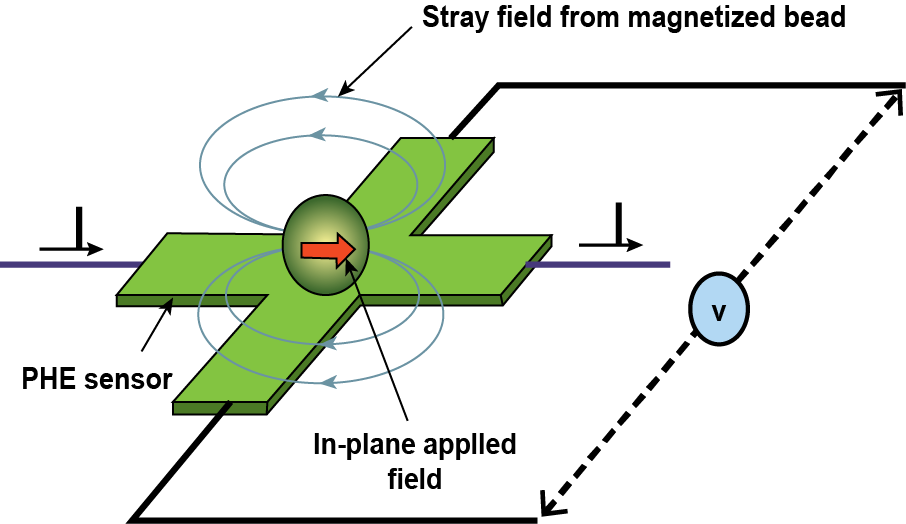
Figure 26.04: Schematic of Planar Hall Effect Sensor in the Hall cross geometry configuration.
The sensor responds to magnetic field components in the sensor plane as opposed to the ordinary Hall sensor, which measures field components perpendicular to the sensor plane.
By utilizing proper fabrication process, the magnetization is confined to one certain direction in zero applied field and the application of a perpendicular field changes the magnetization state in such a way that the electronic readout is linear with respect to the magnitude of the applied field. This is true for applied fields smaller than a fourth of the intrinsic effective anisotropy field.
The planar Hall's sensor has been demonstrated as a magnetic bead detector to measure the earth's field with nanotesla precision. Also, the planar Hall sensor can be used as sensing principle in a magnetic bioassay.
Quiz 26:
(Q26.1) Can we produce the Hall voltage by applying the magnetic field in a circulating manner?
(Q26.2) How do we identify the nature of the semiconductor using Hall voltage?
(Q26.3) Can you think of any other applications for the Hall probe?