Hall effect:
• This effect discovered by Edwin Hall is the production of a voltage difference across an electrical conductor, transverse to an electric current in the conductor and a magnetic field perpendicular to the current.
• The Hall coefficient useful for the determination of the charge carriers and type is defined as the ratio of the induced electric field to the produce of the current density and the applied magnetic field.
• This effect is also useful for the determination of the magnetic field in most of the magnetometers.
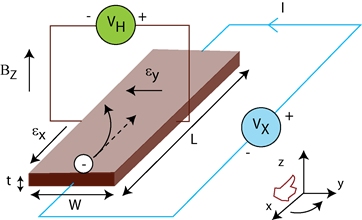
Figure 26.01: Schematic of Hall effect set up.
Consider a rectangular bar with thickness, t, Length L, and width W, as shown in Figure 26.01 and the current I flows through the sample in the presence of magnetic field applied perpendicular to the current direction, i.e., along the thickness direction.