• The identification of crystal structure of unknown materials has been performed usually with a powder XRD. Powders, containing aggregation of fine grains with a single crystal structure, but oriented randomly, when exposed to X-rays, the diffraction intensity is assumed to be the sum of the X-rays reflected from all the fine grains. Hence, we can observe the diffraction peak attributed to Miller indices of the powders.
• For known materials, there is a database maintained by the International Center for Diffraction Data (ICDD) or Joint Committee on Powder Diffraction Standards (JCPDS) for the identification of inorganic and organic materials with a crystal structure.
• One can identify the unknown materials by comparing their diffraction patterns and the database. In addition, XRD patterns can be used for (i) identification of crystalline phases and their degree of crystallization, (ii) estimating crystallite size and (iii) residual strain.
Information obtainable from a diffraction pattern:
Figure 3.01 depicts the schematic of XRD pattern and information obtainable.
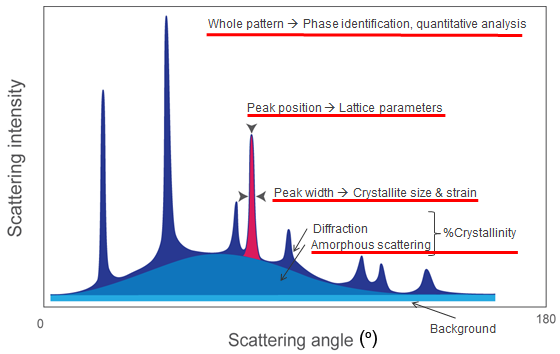
Figure 3.01: Schematic of XRD pattern.