6 Error analysis
There are two types of error in Monte Carlo simulation: statistical error and systematic error. Statistical error arises as a result of random changes in the simulated system from measurement to measurement and can be eliminated by generating a large number of independent samples. Systematic error is due to the procedure adopted to make a measurement and that affect the whole simulation.
6.1 Statistical error:
Suppose a quantity x is distributed according to a Gaussian distribution with mean value <x> and width σ. Consider N independent observations  of this quantity x. An unbiased estimator of the mean <x> of this distribution is

and the standard error of this estimate is

In order to estimate the standard deviation σ itself from the observations, consider the deviation  . Trivially we have
  . Thus we are interested in mean square deviation

The square of standard deviation is the variance and it is given by

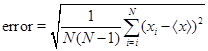
Thus, the error in the estimation of mean <x> is given by
6.2 Systematic error:
Since the systematic errors do not appear in the fluctuations of the individual measurement, they are more difficult to estimate than statistical errors. The main source of systematic error in the Ising Model simulation is the choice of finite number of MC time steps to equilibrate the system. There is no good general method for estimating systematic errors. Each source of such error has to be considered separately and a strategy has to be identified.
Problems
Problem 1: Check that the Metropolis transition probability satisfies the detailed balanced condition.
Problem 2: Simulate the zero field spin- 1/2 Ising model on a 2d square lattice employing Metropolis algorithm. Calculate per spin magnetization and susceptibility of the system as a function of T. Determine  .
.