The energy  of a state n can be obtained as
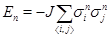
setting  . However, in Metropolis algorithm we calculate the energy difference
  in going from state n to state m. Thus, one can calculate energy of a state m as

Knowing the value of energy E, one may calculate the per spin specific heat as

assuming  . E and
  is plotted as a function of temperature T in Fig.8.6.
In order to take average of a physical quantity, we have presumed that the states over which the average has been made are independent. Thus to make sure that the states are independent, one needs to measure the "correlation time'' τ of the simulation. The time auto correlation  of magnetization is defined as

The auto correlation is expected to fall off exponentially at long time

Thus, at  , drops by a factor of
  from the maximum value at
  . For independent samples, one should draw them at an interval greater than τ. In most of the definitions of statistical independence, the interval turns out to be
  .
.
Application Monte Carlo technique in different fields of condensed matter could be found in K. Binder (Edt.), The Monte Carlo Method in Condensed Matter Physics , (Springer-Verlag, Heidelberg, 1992) [3].
The difficulties one usually encountered are primarily limited computer time and memory and secondly statistical and other errors. To encounter these difficulties, one may begin with a relatively simple program using relatively small system size and modest running time. The simulation can be performed for special parameter values for which exact results may be available. The parameter range, system size and computer time then can be optimized to obtain reasonable result with less error.