3.2 Minimization of free energy: Bragg-Williams
Consider a system described by the Hamiltonian  . The corresponding free energy of the system is given by
  where
where  is the canonical partition function of the system. F is the true free energy of the system. Let us take a trial Hamiltonian
  whose corresponding free energy is
  where
where 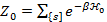 . Now say,

and the partition function is given by
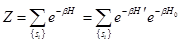
Therefore one has,
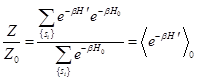
where  denotes an average taken in the ensemble defined by . Due to convexity property,
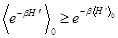
and it follows that

then one has
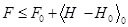
This is called Bogoliubov inequality. If the trial Hamiltonian is given by

where the unknown parameter λ is the effective field, the mean field free energy can be obtained minimizing  by varying λ. The single particle partition function
  and free energy
  corresponding to is given by

and then  . The second term on the right hand side of Bogoliubov inequality can be calculated as

where  . Thus, for system of N spins on a lattice of coordination number z,
  is given by

where the factor of 1/2 is to take care of double counting of pairs over the whole lattice. Then by Bogoliubov inequality one has
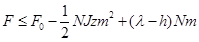
Taking derivative of the right hand side with respect to λ and setting it to zero we could determine λ as,
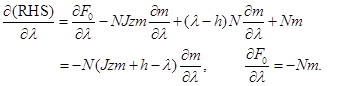
The derivative to become zero,  should be zero. Therefore,
  and hence the magnetization is given by

the same mean field equation as obtained by Weiss. Note that, tanh is due to Ising spins (two states problem) and nothing to do with mean-field approximation.
If  ,
,  is the mean field. The mean field free energy is then given by
